If you ate too many chocolate-covered cherries, or indulged in more eggnog that you shoud've, you're not alone. If you fell off your diet wagon over the holidays, don't panic. Jump back on and get rolling again with these great ideas to recover from your indulgences.
The most basic way to lose weight is to slash calories. That’s Diet 101. But how many do you really have to cut or burn to see results? It’s simple: You can drop a pound a week by trimming 500 calories each day. (Calories burned are based on a 150-pound woman.) In fact, do a couple of swaps a day and you can drop 10 pounds in five weeks! So try these 50 easy tweaks—and get the slim body you want in no time.
1. Shake your groove thing. Dance for just two hours and torch 500 calories. (A little air guitar will burn a few extra calories, too.)
2. Get enough sleep. A lack of shut-eye can make you snack, new research from the University of Chicago shows. People who got only 5 1/2 hours of sleep noshed more during the day. Snooze more and save about 1,087 calories.
3. Don’t eat in front of the TV. You’ll eat up to 288 calories more, according to research from the University of Massachusetts. Instead, eat at the table, and trade one hour of TV for a casual walk. Together, that’s 527 calories burned.
4. Get in tune with your tummy. Pay attention to how full you feel, and put down your fork when you’re satisfied. Listen to your body’s cues—instead of looking at whether the plate is clean—and save up to 500 calories a day.
5. Limit dinner guests. Eating with seven or more other guests can make you eat 96 percent more food, says Brian Wansink, Ph.D., author of Mindless Eating. That’s like doubling your dinner! Dine with fewer guests to save 500 or more calories.
6. Simple tricks to fill up (with less!). For breakfast, eat two boiled or poached eggs. (You’ll feel fuller and eat about 416 fewer calories the rest of the day.) Before lunch and dinner, enjoy 1 cup low-cal soup. (You’ll eat about 134 calories less at each meal.) And save a total of 684 calories for the day.
7. Limit salad toppings. A big salad might seem healthy, but all those goodies on top can make it more calorie-laden than lasagna or fettuccine Alfredo. Cheese crumbles, caramelized nuts, bacon, avocado, dried fruit, croutons and vinaigrettes can add lots of calories. Save 500 or more calories by having just one topping, adding flavorful but lower-cal veggies (roasted bell peppers, grilled onions, or mushrooms) and using half the dressing.
8. Don’t clean your plate. Leave 25 percent of your food on the plate at every meal, says weight-loss expert James O. Hill, Ph.D., author of The Step Diet. If you normally eat 2,000 calories or more each day, you’ll cut 500 calories.
9. Use smaller plates. Swap your 12-inch plate for a 10-inch one. You’ll eat 20 to 25 percent less—and save up to 500 calories. You won’t feel any less full, either, researchers say.
Bing Search: Weight Loss View results for: Cut Calories Healthy Eating Workout Routines
10. Serve and sit. Family-style meals, with platters and bowls of food on the table, invite people to go back for seconds and thirds. Cut hundreds of calories by filling plates before bringing them to the table; leave serving dishes in the kitchen, too.
11. Make a swap. Use 1 cup plain fat-free yogurt instead of 1 cup heavy cream in a favorite baking recipe. Save 684 calories.
12. Make mine a mini. Check out menus for small versions of great desserts, so you can dodge calories and end your meal on a sweet note. P.F. Chang’s Great Wall of Chocolate (designed for one diner!) is 1,440 calories. The Mini Great Wall? A chocolatey yet svelte 150 calories. You’ll save 1,290-calories.
13. Ditch that buttered movie popcorn. Yes, the large popcorn at the concession stand weighs in at a whopping 1,005 calories. Smuggle in your own (microwave-popped, 94 percent fat-free, of course) and save more than 700 calories.
14. Count your chips (and crackers). No, you can’t eat your snacks from a large bag or box because it’s waaaay too tempting to eat until the bag is empty. (Remember Oprah’s blue corn–tortilla chip confession?) A chip-bender to the bottom of a 9-ounce bag is 1,260 calories sans the dip. So stick to one serving, about 15 chips—that’s 140 calories—or pick up some 100-calorie snack packs and save 1,120 calories.
15. Step away from the nuts, especially if they’re in a big bowl. The bigger the serving bowl, the more you’ll eat, Cornell University researchers say. Nuts have heart-healthy fats, but they’re also high in calories: One handful (about 1 ounce) of oil-roasted mixed nuts has 175 calories; three handfuls have 525. Cut out nuts altogether and save more than 500 calories. Can’t resist ’em? Eat pistachios: Two handfuls are just 159 calories, and the shelling will slow down your munching.
16. Skip the whip—or at least size it down. Dessert-like coffee creations can contain as many as 670 calories, with large sizes and options like whipped cream, whole milk and syrups. Craving whipped cream? Try it on a shot of espresso for a total of just 30 calories. You save 640 calories!
17. Kick the soda habit. A 12-ounce soft drink has about 150 to 180 calories. If you down two or three a day, you’re getting lots of extra calories. Quench your thirst with water and save as many as 540 calories.
18. Drink sugar-free. A 20-ounce tea with added fruit juices can have 400-plus calories. And Southern-style sweet tea isn’t much better than soda: a 16-ounce bottle of syrupy sweet tea has 180 calories; three of those are 540 calories. Choose sugar-free sips and save more than 400 calories.
19. Skinny up cocktails. Syrups, sour mix, sugary fruit juices and creamy additions turn drinks into desserts: an indulgent Mudslide can have more than 800 calories. Order drinks mixed with club soda, tonic water, cranberry juice or a squeeze of citrus; or try distilled liquors on the rocks. You’ll save up to 800 calories.
20. Eat less pasta. One cup of pasta is just 220 calories. But typical dinner portions at restaurants can be as much as 480 percent larger than that 1 cup, according to New York University research. That’s 1,056 calories. Even if you eat 2 whole cups of noodles, you’ll still save 616 calories.
21. Get out your knitting needles. An afternoon of knitting can burn more than 500 calories (at a rate of about 100 an hour).
22. Clean house. Tidy up for 2 1/2 hours and burn 510 calories.
23. Check the number of servings in a dish. The calorie count on the menu for shrimp fried rice may say 350 calories per serving, but what’s set in front of you may actually contain four servings. Split it with three friends, and save 1,050 calories.
24. Beware the healthy-food trap. People let their guard down when the menu is full of healthy fare, underestimating calories by as much as 35 perecnt, research by the Cornell University Food and Brand Lab shows. You’re also more likely to order drinks, sides and desserts with up to 131 percent more calories when you have a healthy entrée. Skip caloric sides—a cookie, chips—to save 500-plus calories.
25. Build a lean burrito—and you’ll save 630 calories. Here's how:
Instead of a flour tortilla, order lettuce.
Instead of cheese, order guacamole.
Instead of ground beef, shredded pork.
Instead of black beans, order pinto beans.
Instead of rice, order corn salsa
Instead of salsa, order pico de gallo
The reduced calorie options add up to 490 calories—down from 1,120.
26. Think small at the ice cream shop. Even if you indulge in your favorite full-fat flavor, you’ll save as many as 550 calories with a 5-ounce size instead of a 12-ounce.
27. Think thin when it comes to pizza. Eat two slices of a medium thin-crust veggie pizza (360 calories) instead of two slices of a large, meaty deep-dish pizza (940 calories) and save 580 calories.
28. Beware hidden oils. Ask to have your food cooked with a little stock instead of oil, or order steamed or poached entrées: you’ll save 124 calories per tablespoon of oil. Also, have the kitchen skip oils added at the last minute like basil oil or chive oil, and save another 40 calories per teaspoon.
29. Order spaghetti with meat sauce instead of spaghetti with Italian sausage and save 560 calories. Even better: Order mushroom ravioli (670 calories) or pasta marinara (430 calories).
Bing Search: Weight Loss View results for: Cut Calories Healthy Eating Workout Routines
30. Nix that smoothie a day. A large 32-ounce smoothie can have 800 or more calories. That really adds up if you’re having on-the-go breakfast several times a week. Instead, try a filling lower-calorie starter of oatmeal with brown sugar and banana slices, and a cup of black coffee. You’ll save 518 calories.
31. Help a friend move. You’ll burn more than 600 calories in one hour of carrying boxes and furniture up and down the stairs.
32. Shovel snow. Clearing the driveway and sidewalks for one hour and 15 minutes will torch 510 calories.
33. Ice-skate for one hour and five minutes and burn 516 calories. (Or go inline skating and slash 562.)
34. Tap your foot. Your skinnier friends are probably fidgeters, who burn up to 350 calories a day just by tapping their feet or being restless. Try it for a few days. Walk around while you’re on the phone, or tap out a tune with your hands or feet (in the privacy of your own office, of course).
35. Be the hostess with the mostest. Go grocery shopping for one hour, put away your groceries, spend two hours cooking a fabulous holiday feast, set the table and serve. Then toast yourself for the awesome 640 calorie-burn. (A glass of champagne is only about 106 calories, so you’re still ahead.)
36. Go window-shopping. Whether you buy anything or not, an afternoon of walking around and trying on clothes can torch 548 calories.
37. Hit the pool. Do one hour of laps or 55 minutes of jogging in the water to burn 500 calories.
38. Stroll your way slim. Spend an afternoon pushing junior from the giraffes to the sea lions at the zoo (or around the aquarium or museum) and burn 523 calories.
39. Head to a county fair or amusement park. You’ll slash 612 calories in three hours from the casual walking and standing in lines. (Subtract 105 calories if you have cotton candy.)
40. Play a game of touch football or basketball with your kids for one hour and burn 500 calories.
41. Head for the nearest hill. Go sledding with the kiddos for one hour and five minutes. You’ll burn 500-plus calories.
42. Do an hour of circuit training and you’ll burn 544 calories.
43. Tackle the garage. Clearing out junk for 1 hour and 30 minutes will burn 510 calories.
44. Rake the leaves. Do yard work for 1 hour and 45 minutes and burn 512 calories. (Jumping in the leaf pile won’t hurt, either.)
45. Kickbox. Sign up for kickboxing and burn 510 calories in a 45-minute class.
46. Go cross-country skiing for one hour and five minutes and sizzle off 516 calories.
47. Exercise at home. Pop in a one-hour aerobics DVD, and finish with 20 minutes of yoga—500 calories, gone.
48. Walk or run a 10K and you’ll burn up to 680 calories.
49. Go hiking. Just one hour and 15 minutes will burn 510 calories.
50. Cut down your own Christmas tree. Hike out, find the perfect tree, cut it, and take it home. Put it up and decorate it for 1 hour to burn 519 calories.
-Source: MSN Health
Showing posts with label Benefits. Show all posts
Showing posts with label Benefits. Show all posts
Monday, December 14, 2009

Tuesday, December 1, 2009
The 5 Rules of Flat Abs

Most of us don't stress about a bit of belly fat hanging over our waistbands during the winter—after all, damage control is just a body-shaping undergarment away, right? But what if you're headed to a place where not even Spanx can save you: the beach or the pool?
The frustrating reality is that the midsection is one of the trickiest areas to tone. That's why even women dedicated to regular exercise often can't iron out their abs. Fortunately, I've come up with some tips and tricks for the ultimate tummy—flattening plan. Not only is it super effective, but it's likely loads easier than the agonizing ab workouts you've been putting yourself through (that are probably getting you no results!).
RULE #1: Attack your hidden core muscles.
Crunches target only superficial muscles, so they aren't the most efficient way to work your abs. Fact: To burn one pound of fat, you have to do 250,000 crunches. That's 100 crunches a day for seven years. Uh, no thanks. Instead, you should target the muscles that lie beneath the superficial ones: your transverse abdominis, multifidis, and internal obliques. Strengthening them pulls in your middle like a corset, keeping the area looking flat and toned. Core moves like planks or mountain climbers (see below) target these "hidden" muscles. To practice engaging them, try this drill: Lie on your back and place your palms just below your navel. Exhale and allow your tummy to expand as far as you can, then focus on pulling your belly button toward your spine, drawing your abdomen toward the floor. Hold for 5 seconds. Repeat 8 to 10 times.


RULE #2: Move your butt.
Your booty and your belly are unlikely partners in crime. Here's why: Over time, sitting around too much renders your glutes practically useless and causes your hip flexors—the muscles that connect your hipbones to your legs—to become stiff. This couch-potato combo tilts your pelvis forward, which increases the arch in your back and puts stress on your spine. From a cosmetic standpoint, it pushes your abdomen out, making even a relatively flat stomach bulge. That means that to lose your gut, you've got to work your butt. Exercises like the single-leg deadlift and hip-glute raise (see below) will help you get a stronger behind. Combat tight hip flexors with this stretch: In a lunge position, lower yourself so your back knee is resting on the floor. Push your hips forward, keeping your back upright, until you feel a stretch in the front of the hip. Hold for 10 seconds, relax, and repeat. Switch legs. You can increase the stretch by reaching your arms over your head.
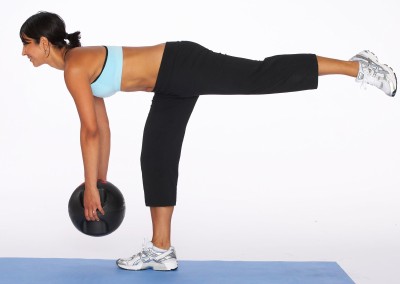

RULE #3: Eat flat-belly foods.
You can't see ab muscles if they're buried under a layer of fat. Excavate them by following these easy dietary guidelines.
*Pump up your protein intake. Substituting meat, fish, dairy, and nuts for carbs can reduce the amount of fat around your middle. Researchers have discovered that when people exchange carbohydrates in favor of an equal amount of protein, they reduced overall belly fat.
*Eliminate added sugar. The average American eats about 20 teaspoons of sugar daily in the form of processed foods like soda, baked goods, breakfast cereals, fruit drinks, and even flavored yogurt. That's about 325 empty calories every day. All that sugar increases insulin production, which slows your metabolism.
*Don't fear fat. Research shows that diets containing more than 50 percent fat are just as effective for weight loss as those that are low in fat. Fat is filling and adds flavor to your meals—both of which help you avoid feeling deprived, so you can stick to your diet. Eat foods rich in monounsaturated fats, such as olives, nuts, and avocados; research has even found that it's OK to enjoy whole foods that contain saturated fat (including milk, cheese, and butter) in moderation.
*Beat the bloat. No matter how much ab fat you lose or muscle you tone, if you're bloated, you won't look (or feel!) your best in a swimsuit. Carbonated beverages, and even good-for-you foods such as beans and broccoli, can make your stomach swell. And keep your sodium intake in check: Nutritionists suggest you stay under 2,000 milligrams to avoid retaining excess water. (Most of us get closer to 5,000 a day.)
RULE #4: Stop stressing.
Your kids. Your in-laws. Your never-ending to-do list. I get it—life is hard. But anxiety can produce extra cortisol, a hormone that encourages the body to store fat, particularly in your belly. According to researchers, your midsection is four times as likely as the rest of your body to store stress-induced fat. Help keep anxiety in check by taking little breaks from work every 90 minutes. Another way stress sabotages your abs: When tension runs high, we reach for fattening foods. To keep your hand out of the office candy jar, keep it out of reach. In one study, participants who had to walk six feet to reach the candy ate up to seven fewer chocolates per day than when the jar was conveniently located at their desk.
RULE #5: Work your abs less often.
Ditch your daily ab workouts. You need only three sessions a week to see maximum results. Training every day with endless crunches won't flatten your belly faster. You'll see benefits quicker if you give your muscles a day to fully recover between workouts. That's because stressing your muscles during a workout breaks down the tissues, and they need rest days to rebuild and get stronger. What's more, you should stick to only 15 to 20 reps of each move. If you can easily do that many, it's time to for harder moves. And if flat abs are important to you, promote them to the top of your fitness to-do list. A lot of people exercise their abdominal muscles at the end of their workout, and that's when you get sloppy or run out of time. You should do them first, and then move on to your cardio. To get them looking great, you need to make them a priority. You'll be glad you did.
Sunday, October 25, 2009
Pump up, slim down

Tired of sweating all over every piece of cardio equipment at the gym and still getting zero love from the scale? You need more iron. And not in your diet—in your hands. According to the National Center for Health Statistics, a mere 21 percent of women strength train two or more times a week. What you don't know: When you skip the weight room, you lose out on the ultimate flab melter. Those two sessions a week can reduce overall body fat by about 3 percentage points in just 10 weeks, even if you don't cut a single calorie. That translates to as much as three inches total off your waist and hips. Even better, all that new muscle pays off in a long-term boost to your metabolism, which helps keep your body lean and sculpted. Suddenly, dumbbells sound like a smart idea. Need more convincing? Read on for more solid reasons why you should build flex time into your day.
Torch Calories 24/7. Though cardio burns more calories than strength training during those 30 sweaty minutes, pumping iron slashes more overall. A study in The Journal of Strength and Conditioning Research found that women who completed an hour-long strength-training workout burned an average of 100 more calories in the 24 hours afterward than they did when they hadn't lifted weights. At three sessions a week, that's 15,600 calories a year, or about four and a half pounds of fat—without having to move a muscle. What's more, increasing that afterburn is as easy as upping the weight on your bar. In a study in the journal Medicine & Science in Sports & Exercise, women burned nearly twice as many calories in the two hours after their workout when they lifted 85 percent of their max load for eight reps than when they did more reps (15) at a lower weight (45 percent of their max). There's a longer-term benefit to all that lifting, too: Muscle accounts for about a third of the average woman's weight, so it has a profound effect on her metabolism, says Kenneth Walsh, director of Boston University School of Medicine's Whitaker Cardiovascular Institute. Specifically, that effect is to burn extra calories, because muscle, unlike fat, is metabolically active. In English: Muscle chews up calories even when you're not in the gym. Replace 10 pounds of fat with 10 pounds of lean muscle and you'll burn an additional 200 calories a day without even trying.
Target Your Trouble Spots. If you've ever tried to ditch the saddlebags and ended up a bra size smaller instead, you know that where you lose is as important as how much. As great as it might be to see the numbers on the scale go down, when you're on a strict cardio-only program your victory is likely to be empty. A recent study at the University of Alabama at Birmingham compared dieters who lifted three times a week with those who did aerobic exercise for the same amount of time. Both groups ate the same number of calories, and both lost the same amount—26 pounds—but the lifters lost pure chub, while about 8 percent of the aerobicizers' drop came from valuable muscle. Researchers have also found that lifting weights is better than cardio at whittling intra-abdominal fat—the Buddha-belly kind that's associated with diseases from diabetes to cancer. Just don't rely exclusively on the scale to track your progress in the battle of the bulge. Because muscle is denser than fat, it squeezes the same amount of weight into less space. "Often, our clients' scales won't drop as fast, but they'll fit into smaller jeans," says Rachel Cosgrove, owner of Results Fitness in Santa Clarita, California. And it's the number on the tag inside your bootcuts you want to get lower, right?
Start Pumping. Begin with three weight-training sessions each week. For the greatest calorie burn, aim for total-body workouts that target your arms, abs, legs, and back, and go for moves that will zap several different muscle groups at a time—for example, squats, which call on muscles in both the front and back of your legs, as opposed to leg extensions, which isolate the quads. For each exercise you do, try to perform three sets of 10 to 12 reps with a weight heavy enough that by your last rep you can't eke out another one without compromising your form. To spark further muscle building, William Kraemer, Ph.D., a professor of kinesiology at the University of Connecticut, suggests alternating moderate-intensity workouts of 8 to 10 reps with lighter-weight 12- to 15-rep sets and super-hard 3- to 5-rep sets. And remember to fuel your workout properly. Too many dieters make the fatal error of cutting back on crucial muscle-maintaining protein when they want to slash their overall calorie intake. The counterproductive result: They lose muscle along with any fat that might have melted away. Sports nutritionist Cassandra Forsythe, Ph.D., co-author of The New Rules of Lifting for Women, recommends that you eat one gram of protein for every pound of your body weight that does not come from fat. For instance, a 140-pound woman whose body fat is 25 percent would need 105 grams of high-quality protein. That's roughly four servings a day; the best sources are chicken or other lean meats, soy products, and eggs. Ready to turn yourself into a lean, mean, calorie-torching machine? Then go get pumped!
Source: Womens Health
Sunday, August 30, 2009
Determining the Best Workout for Your Body Type, Part 1

I have been asked this question by quite a few people and clients in the past and even recently, "What's the best workout for my body shape/type?" While any type of activity to increase the heart rate and work the muscles is good, there are specific kinds of exercise that might be better than others to target your particular body shape. Before we really address which specific exercises are best for your body type (which will be Part 2, stay tuned next week), we have to first determine which body type we are. I found the below article on-line that I believe is pretty accurate on describing each body type in detail. This was pretty interesting though and I learned that I'm indeed a mesomorph (no surprise there!).
"People come in all shapes, but most can be placed into a particular category of body type, mesomorph, ectomorph, or endomorph. These body types have different characteristics, and you should tailor your workout to whichever you belong. Here's the skinny on the different types of bodies:
A mesomorph (or meso, for short) can be defined in one word: muscular. If you're a meso, your body type is usually the envy of all gym rats because you can increase your muscle size quickly and easily. The well-developed, rectangular shapes of mesomorphs are representative of their thick bones and muscles. (Before you get too excited about this perfect form, keep in mind that being a meso may also mean you have poor flexibility.) If you are a characteristic mesomorph, you have a well-defined chest and shoulders that are both larger and broader than your waistline. Your abdomen is taut and your hips are generally the same width as your shoulders. Your buttocks, thighs, and calves are all toned and defined.
As muscularly defined, athletic-looking individuals, mesomorphs are full of energy, are physically capable of a lot of activity, and tend to be aggressive athletically. (Usually no couch potatoes in this group.) Although mesomorphs generally store fat evenly all over their bodies, they can become overweight if they are sedentary and consume a high-fat and/or high-calorie diet.
Cardiovascular disease can be a primary threat to an overweight meso, so if you fit into that category, your best method of prevention is to maintain a healthy diet and a balanced exercise regime. Remember that your heart is a muscle, too, and the best way to keep it fit is to perform cardiovascular activities.
Craving physical activity and constantly seeking action, the mesomorph makes a great athlete. As a meso, you excel in sports that require great strength, short bursts of energy, and lots of power. Mesos are always popular in gym class and at the playground, because people want mesos on their teams. If you're scouting for body types at your local gym (and who isn't?), you will most likely find your fellow mesos lifting weights and avoiding the cardio equipment like step machines or treadmills.
A one-word description for the ectomorph body type (or ecto, for short) is slim. If you're an ecto, mesomorphs and endomorphs usually don't want to stand next to you. It's not that ectomorphs aren't personable, it's just that you're probably a tall, slender individual who has trouble gaining weight (oh darn!). As you may have guessed, the perfect example of an ecto is a fashion model.
An ectomorph is relatively linear in shape with a delicate build, narrow hips and pelvis, and long arms and legs. As an ecto, your muscle and bone outlines are usually visible (especially if you are an extremely thin ecto), and you normally have less fat and muscle mass than people with other body types. Remember, though, that you probably don't have all the features of a characteristic endomorph, but a blend of features from more than one body type.
Although willowy ectomorphs cover the majority of fashion magazines, nobody's perfect, and ectos do have health concerns. Your primary concern as an ectomorph is your frail stature consisting of small bones and joints that have a tendency to be injured easily during sporting activities.
You probably won't be the star of your football team or the next champion gladiator. Don't worry — your body type is naturally suited to perform wonderfully in endurance activities. Just remember: Balancing your activities is the key. Like mesomorphs, ectos have a tendency to stick with what they do best, and ectos excel at cardiovascular training. You find balance in your workouts when you do both aerobic and strength training.
A one-word description of the endomorph body type (or endo, for short) is curvy. The soft, flowing curves of an endo are similar to that of an hourglass in more ways than one. And wouldn't you know it; the sands of an hourglass tend to settle in its bottom half just like the fat in the body. Comparatively, if you're an endomorph, your body fat may have a tendency to settle into the lower regions of your body, predominantly the lower abdomen, hips, and thighs, rather than being distributed evenly throughout your body. Keep in mind, though, that most endomorphs don't have all the features of characteristic endomorph, but a blend of features from other body types as well.
An endomorph body typically has the capacity for high fat storage, and unfortunately puts fat on pretty easily. Although all body types are susceptible to excessive weight gain, as an endomorph, you are more inclined to become obese. The majority of your body weight is either centered in the middle of your body or in your hip and buttocks regions. A metaphor frequently used to describe an endomorph body type is pear-shaped. A pear resembles a body that has more weight in the lower region, like the hips and thighs, than the upper portion of the body. Structurally, as an endo, you have small to medium bones, limbs that are shorter in relation to your trunk, and musculature that is not well defined.
Now for the good news. From top to bottom, your soft swelling curves create full, rounded shoulders, limbs, and a full trunk. Voluptuous and sensual are the descriptions given to many endomorph females whose soft body contours and deep curves create an allure like that of Marilyn Monroe.
A male endomorph (known as an android) tends to have a different fat distribution pattern from a female endomorph (known as a gynoid). Female endos usually collect fat in their butts, legs, and hips, while most males collect fat in their abdomen (the "spare tire" or "love handle" look). Many research studies have shown that abdominal fat deposition is much more dangerous than fat in the leg and butt area. This is primarily due to the danger of heart disease and an increased risk of diabetes, stroke, some cancers, and high blood pressure.
The key to taking the bad with the good and finding happiness with your body type is by balancing all aspects of your life. Your first concern is your health, and your major health concern as an endo is maintaining a healthy body weight. Excessive amounts of body fat can place you in jeopardy of cardiovascular disease. Remember that the risk of such disease is increased if the majority of the fat is carried in the center of your body surrounding your heart. This danger can easily be avoided by maintaining a healthy diet and exercising. The joints of your lower body may be another health concern. Because these joints are already highly susceptible to injury, high-impact sports or activities may be damaging to them, especially if you carry excess body weight."
Source: www.dummies.com
Sunday, August 23, 2009
Hot Fitness Trends for 2009
If you're wondering what are the hottest trends in fitness this year or even just wanting to "change it up" a bit, here's some fantastic ideas that will be sure to make you sweat, burn some calories, and tone your muscle! The list I found is from ACE (American Council of Exercise) and ranks 1 to 10.
1. Boot camp-style fitness programs. Haven't tried it? Look up a bootcamp in your area and give it a try-you're bound to burn 600 calories in ONE class!

2. Workout plans that are less expensive. (With the economy and all.)
3. Specialty classes like Zumba, Bollywood, Afro-Cuban, and ballroom dancing. These classes are set to rhythmic music and aim to increase cardiovascular fitness while folks have fun.

4. The basics. Fitness professionals believe that people will want to return to basic fitness programs.
5. Circuit training. Circuit training blends strength training and cardiovascular activity at different intensities. Another plus: gyms can set up their own circuit for members to follow.

6. Kettlebell training. These iron weights, traditionally used in Russia, aim to develop whole body fitness and core strength. A fun twist to strength training!

7. Boomer fitness. A focus on fitness led by people 50 and older.
8. Technology-based fitness. Using high-tech gadgets like iPods to help keep workouts engaging, plus an increase in interactive fitness video games.

9. Event or sports-specific exercises. A focus on the simple things, like basketball or volleyball games, or day bike rides. Even triathlons!

10. Mixing it up. Low-intensity cardio or weight training on one day, followed by a high-intensity workout on another day
1. Boot camp-style fitness programs. Haven't tried it? Look up a bootcamp in your area and give it a try-you're bound to burn 600 calories in ONE class!

2. Workout plans that are less expensive. (With the economy and all.)
3. Specialty classes like Zumba, Bollywood, Afro-Cuban, and ballroom dancing. These classes are set to rhythmic music and aim to increase cardiovascular fitness while folks have fun.

4. The basics. Fitness professionals believe that people will want to return to basic fitness programs.
5. Circuit training. Circuit training blends strength training and cardiovascular activity at different intensities. Another plus: gyms can set up their own circuit for members to follow.

6. Kettlebell training. These iron weights, traditionally used in Russia, aim to develop whole body fitness and core strength. A fun twist to strength training!

7. Boomer fitness. A focus on fitness led by people 50 and older.
8. Technology-based fitness. Using high-tech gadgets like iPods to help keep workouts engaging, plus an increase in interactive fitness video games.

9. Event or sports-specific exercises. A focus on the simple things, like basketball or volleyball games, or day bike rides. Even triathlons!

10. Mixing it up. Low-intensity cardio or weight training on one day, followed by a high-intensity workout on another day
Sunday, August 16, 2009
How to Resist Temptation

In a world where you can inhale half of your daily caloric intake as you exit the drive-thru, often the only thing standing between you and a few extra chins is willpower-that oh-so-elusive ability to stop the urge to indulge. If your powers of resistance are lacking, you'll be glad to hear that research actually shows that willpower is a kind of mental muscle, and like any muscle, it can get stronger. These four tactics target the most common resolve busters. Put them into practice, and pretty soon that jelly glazed doughnut or that triple fudge brownie will be no match for your mental strength.
Rule #1: Eat smaller, more frequent meals
What it targets: Out-of-control hunger
Why it works: Going too long without eating makes your blood sugar levels plummet. That leaves you feeling ravenous and with an appetite that can overpower any sense of logic or best intentions to eat well. If you have small meals every 3 hours, your blood sugar remains stable, preventing the wallop of a sugar low that will leave you vulnerable to overeating. Did you know that that your blood sugar levels do more than affect how hungry you get? They're also directly connected to willpower. So, reach for snacks in between meals that balance carbohydrates with protein like low-fat yogurt and berries or an apple and a handful of almonds. When you do this, you will keep blood sugars at bay and stay fuller longer.
Rule #2: Eat with your other hand
What it targets: Distraction or eating too quickly
Why it works: Picking up a fork with the hand you don't usually use while eating slows you down and makes you focus on your meal and eat at a slower pace, two things that have been proven to aid weight loss. Studies have shown that that with regular practice, this kind of switcheroo can also increase your overall willpower. Also, by eating slower, your brain is able to tell your stomach when you're satisfied and you'll end up eating less.
Rule #3: Weigh yourself regularly
What it targets: Losing sight of your goal
Why it works: Few things keep your weight loss goal front and center better than seeing those big glowing numbers on the scale. Regular weigh-ins also make it easier to notice extra pounds creeping on, so you can slash and burn immediately. Researchers have found in studies that those that weighed themselves frequently, daily or weekly, lost more weight than those that didn't. Actually, about DOUBLE the amount of weight of those that didn't step on the scale often. But keep in mind, that your weight is going to fluctuate to some degree. Your clothing, the time of day, and how much water you're retaining all affect your weight, so don't be discouraged if that number goes up a few pounds suddenly. Also, break your goal weight into several smaller targets-first aim for five pounds, then after you hit that, go for another five. Studies have shown that the more frequent and specific your weight loss objectives, the better your chances to sticking to them.
Rule #4: Lift your spirits
What it targets: Emotional eating
Why it works: It's estimated that when people overeat, nearly 75% of the time it's because they're feeling blue. It stands to reason that lifting your spirits might also help you take your mind off munching. Studies have shown that small doses of pleasant emotions can quickly renew your ability to say no. So, go do something you enjoy, go for a walk outside, talk on the phone, read...just find something to do that you enjoy and makes you happy-it might be temporary, but it will help sustain your urge to splurge.
Source: Women's Health
Thursday, April 23, 2009
Fitness IQ Test Answered
1. C. Strength training. Your BMR (Basal Metabolic Rate) is the number of calories you burn during the day at rest, meaning if you laid in bed all day, this is how many calories you would burn. For most women, this number is between 1200-1600 calories/day. (The best way to find this number is to get tested.) This is an average of course, and obviously will vary. The higher your muscle mass ratio, the higher your BMR is (which is a good thing!). The only way to increase this number is to add muscle. And the only exercise that can add muscle is strength or resistance training. For every 1 lb. of muscle added, add 50 calories to your BMR. That’s more calories you burn everyday doing NOTHING!!!
2. FALSE. A common misconception is that in order to burn fat, you need to stay within the lower range of your Target Heart Rate zone (THR). In fact, any heart rate WITHIN your THR will burn fat. Why? Because the THR is your “aerobic” zone, meaning your muscles are working in an oxygen-rich environment, which is conducive to burning fat. Anything below that range isn’t considered aerobic, and above that range is anaerobic, at which point you are utilizing lactic acid. While it is good to have spurts of intense, huffing and puffing intervals of anaerobic exercise, you don’t want to have an ENTIRE workout in the anaerobic zone. Basically, you want BOTH your heart rate and breathing to be elevated. Here’s how we will figure out YOUR THR.
Take 220-your age=age-adjusted maximal heart rate (220-31 (my age)=189)
Figure out 65% of that number (Multiply 189 X .65=123)-low end of THR
Figure out 85% of that number (Multiply 189 X .85=160)-high end of THR
3. B. How high your heart rate is. A little bit of a trick question. Notice I emphasized BEST. While the other answers can be an indication of how hard you’re working, nothing is better than knowing what your HR is. Why do you think this is the most effective way to know how hard you’re pushing yourself? Because sometimes going by our “Perceived Exertion” isn’t always accurate. How much we’re sweating, how hard we’re breathing, or how fatigued we feel don’t always tell us WHERE we are working along the THR. Just as talked about in the last question. If we don’t own a HR monitor (which I highly recommend buying one-they’re not expensive), we can perform this self-check every 5 min by finding our pulse on our wrist or neck, timing it for 10 sec and multiplying that number by 6.
4. FALSE. Here’s a BIG misconception. Women do not have near the levels of testosterone that men do to build muscle. We aren’t genetically programmed to do that and would have to take anabolic steroids to see any serious amount of muscle mass built. The reason many women feel they appear “bulky” from lifting weights is because they have an extra layer of fat over their muscle! Shed the fat, and what do you see? A lean, mean muscle machine!
5. FALSE. Another big myth. Many people believe that the energy boost you get from exercise is a double-edged sword. It’s a great pick-me-up in the morning, but if you work out at night, you may not sleep well. If this was gospel truth, morning people would rule the world! Fortunately for night owls, there is no one best time to exercise. It’s a matter of what you prefer. Fitting exercise into your daily routine is the main issue. Just remember to wait at least 2 hours after eating before working out. And no, working out is unlikely to keep you up at night. As long as you don’t exercise too close to bedtime, you will probably sleep better on the days you work out.
6. E. All of the above. While many think running is the best way to lose weight, this isn’t necessarily true. It doesn’t matter what type of exercise you do. Of course, different exercises might burn more calories than others, but it’s all about intensity here. It might not take much to get your HR elevated up running, but maybe biking it takes a little more effort? Well, then work intervals into your routine-short bursts of speed, hills, or an increase in resistance to get that HR up! Just remember, it’s all about intensity, duration, and frequency. And the bottom line is, you have to ENJOY IT! If you’re not a runner and hate doing it, then why force yourself to do something you dread? It’s best to find activities we prefer, so we can stick to them and maintain healthy lifestyle habits!
7. FALSE. This is a big misconception and something I hear a lot, especially from women over 30! “It just seems like it’s so much harder to lose the weight now!” We’ve all heard or thought this before, right? So, why isn’t this true? The solution is going back to increasing our metabolisms, our BMR’s. While it is true that we start to lose muscle after age 30, that doesn’t mean we can’t stop it or reverse the effects of this! If we add a little muscle mass by strength training (which will also be good for our bones as we age!), continue exercising, and watch we eat, then we are not DOOMED and we can look younger and FABULOUS!
8. FALSE. You might not want to hear this, but you could do all the crunches and stomach exercises EVERYDAY and not see any results. While these exercises are great to strengthen and tone our abdominal exercises, they can’t get rid of the fat. To burn fat and flatten your belly, you need to burn more calories. Once you’ve gotten rid of the fat, your washboard abs will become more visible.
9. D. Any of the above can get results. Another trick question! We hear so many different answers to this one, don’t we? This can be very confusing to those trying to lose weight! How much effort do we really need to put in to see results? The answer is anything! Now, while devoting 2 hrs a day 5-6 days a week might deliver results FASTER, it doesn’t mean that’s what is required to lose weight. The key is consistency and the bottom line is CALORIES IN VS. CALORIES OUT. If we can’t or don’t want to devote too much time to exercise, then just focus more on the nutrition (which is 80% of it anyways). I’ve had clients before that did the minimum (3 days a week) and still lost lots of weight, mostly because of their eating habits!
10. TRUE. While this is actually true, it’s also only temporary. Just keep at it and periodically (every 2 to 3 weeks) “up the ante” by changing the frequency, duration, intensity, even type of exercise you’re doing. You should continue to see results if you continue to challenge yourself.
11. FALSE. Not necessarily. You should be working at your predetermined THR. If you exercise too hard and fast, you may be burning fewer calories than in less intense, aerobic workouts. This goes back to when we talked about our THR or aerobic zone, and the anaerobic zone. Again, this doesn’t mean we shouldn’t ever go outside and above our aerobic zone, but that we should keep those bursts of high-intensity exercise limited to a few intervals in each workout. (And it’s also good to go into this anaerobic zone because this is how we increase our heart rate zone and capacity to utilize oxygen!)
12. FALSE. Unfortunately, there's no way to “spot reduce” certain areas. Yes, it’s beneficial to do exercises that target our problem areas, but we should be doing compound exercises that utilize more than those exercises so we can increase our heart rate and burn more calories (and maximize our time!). And going back to the question about getting a 6-pack, it’s all about getting rid of the overlying fat, so we can see those muscles!
2. FALSE. A common misconception is that in order to burn fat, you need to stay within the lower range of your Target Heart Rate zone (THR). In fact, any heart rate WITHIN your THR will burn fat. Why? Because the THR is your “aerobic” zone, meaning your muscles are working in an oxygen-rich environment, which is conducive to burning fat. Anything below that range isn’t considered aerobic, and above that range is anaerobic, at which point you are utilizing lactic acid. While it is good to have spurts of intense, huffing and puffing intervals of anaerobic exercise, you don’t want to have an ENTIRE workout in the anaerobic zone. Basically, you want BOTH your heart rate and breathing to be elevated. Here’s how we will figure out YOUR THR.
Take 220-your age=age-adjusted maximal heart rate (220-31 (my age)=189)
Figure out 65% of that number (Multiply 189 X .65=123)-low end of THR
Figure out 85% of that number (Multiply 189 X .85=160)-high end of THR
3. B. How high your heart rate is. A little bit of a trick question. Notice I emphasized BEST. While the other answers can be an indication of how hard you’re working, nothing is better than knowing what your HR is. Why do you think this is the most effective way to know how hard you’re pushing yourself? Because sometimes going by our “Perceived Exertion” isn’t always accurate. How much we’re sweating, how hard we’re breathing, or how fatigued we feel don’t always tell us WHERE we are working along the THR. Just as talked about in the last question. If we don’t own a HR monitor (which I highly recommend buying one-they’re not expensive), we can perform this self-check every 5 min by finding our pulse on our wrist or neck, timing it for 10 sec and multiplying that number by 6.
4. FALSE. Here’s a BIG misconception. Women do not have near the levels of testosterone that men do to build muscle. We aren’t genetically programmed to do that and would have to take anabolic steroids to see any serious amount of muscle mass built. The reason many women feel they appear “bulky” from lifting weights is because they have an extra layer of fat over their muscle! Shed the fat, and what do you see? A lean, mean muscle machine!
5. FALSE. Another big myth. Many people believe that the energy boost you get from exercise is a double-edged sword. It’s a great pick-me-up in the morning, but if you work out at night, you may not sleep well. If this was gospel truth, morning people would rule the world! Fortunately for night owls, there is no one best time to exercise. It’s a matter of what you prefer. Fitting exercise into your daily routine is the main issue. Just remember to wait at least 2 hours after eating before working out. And no, working out is unlikely to keep you up at night. As long as you don’t exercise too close to bedtime, you will probably sleep better on the days you work out.
6. E. All of the above. While many think running is the best way to lose weight, this isn’t necessarily true. It doesn’t matter what type of exercise you do. Of course, different exercises might burn more calories than others, but it’s all about intensity here. It might not take much to get your HR elevated up running, but maybe biking it takes a little more effort? Well, then work intervals into your routine-short bursts of speed, hills, or an increase in resistance to get that HR up! Just remember, it’s all about intensity, duration, and frequency. And the bottom line is, you have to ENJOY IT! If you’re not a runner and hate doing it, then why force yourself to do something you dread? It’s best to find activities we prefer, so we can stick to them and maintain healthy lifestyle habits!
7. FALSE. This is a big misconception and something I hear a lot, especially from women over 30! “It just seems like it’s so much harder to lose the weight now!” We’ve all heard or thought this before, right? So, why isn’t this true? The solution is going back to increasing our metabolisms, our BMR’s. While it is true that we start to lose muscle after age 30, that doesn’t mean we can’t stop it or reverse the effects of this! If we add a little muscle mass by strength training (which will also be good for our bones as we age!), continue exercising, and watch we eat, then we are not DOOMED and we can look younger and FABULOUS!
8. FALSE. You might not want to hear this, but you could do all the crunches and stomach exercises EVERYDAY and not see any results. While these exercises are great to strengthen and tone our abdominal exercises, they can’t get rid of the fat. To burn fat and flatten your belly, you need to burn more calories. Once you’ve gotten rid of the fat, your washboard abs will become more visible.
9. D. Any of the above can get results. Another trick question! We hear so many different answers to this one, don’t we? This can be very confusing to those trying to lose weight! How much effort do we really need to put in to see results? The answer is anything! Now, while devoting 2 hrs a day 5-6 days a week might deliver results FASTER, it doesn’t mean that’s what is required to lose weight. The key is consistency and the bottom line is CALORIES IN VS. CALORIES OUT. If we can’t or don’t want to devote too much time to exercise, then just focus more on the nutrition (which is 80% of it anyways). I’ve had clients before that did the minimum (3 days a week) and still lost lots of weight, mostly because of their eating habits!
10. TRUE. While this is actually true, it’s also only temporary. Just keep at it and periodically (every 2 to 3 weeks) “up the ante” by changing the frequency, duration, intensity, even type of exercise you’re doing. You should continue to see results if you continue to challenge yourself.
11. FALSE. Not necessarily. You should be working at your predetermined THR. If you exercise too hard and fast, you may be burning fewer calories than in less intense, aerobic workouts. This goes back to when we talked about our THR or aerobic zone, and the anaerobic zone. Again, this doesn’t mean we shouldn’t ever go outside and above our aerobic zone, but that we should keep those bursts of high-intensity exercise limited to a few intervals in each workout. (And it’s also good to go into this anaerobic zone because this is how we increase our heart rate zone and capacity to utilize oxygen!)
12. FALSE. Unfortunately, there's no way to “spot reduce” certain areas. Yes, it’s beneficial to do exercises that target our problem areas, but we should be doing compound exercises that utilize more than those exercises so we can increase our heart rate and burn more calories (and maximize our time!). And going back to the question about getting a 6-pack, it’s all about getting rid of the overlying fat, so we can see those muscles!
Sunday, April 19, 2009
Test your Fitness IQ
Take this test. The answers and explanations will be given in a few days! Good luck!
1. You can increase your metabolism, Basal Metabolic Rate (BMR) by:
A. Running
B. Biking
C. Strength training
D. Any form of exercise
2. TRUE or FALSE If you want to burn fat, it is best to stay in the “fat-burning zone” of your Target Heart Rate (the lower end of your THR) and not the “cardio zone” (the higher end of your THR).
3. The best way to know how hard you are pushing yourself during exercise is by:
A. How tired or sore you are
B. How high your heart rate is
C. How much you’re sweating
D. How hard you’re breathing
E. All of the above
4. TRUE or FALSE Lifting HEAVY weights (strength training) frequently can cause women to get “bulky” and build too much muscle mass.
5. TRUE or FALSE The best time to work out is early in the morning.
6. The best exercise for losing weight is:
A. Running
B. Biking
C. Eliptical/Cross-trainer
D. Strength training
E. All of the above
7. TRUE or FALSE As you age, you lode muscle and gain fat, thereby decreasing your metabolism, no matter what you do.
8. TRUE or FALSE To get ripped abs or a “6-pack”, you should do crunches every day.
9. How much exercise time is needed to lose weight, improve cardiovascular endurance and function, and see results?
A. 3 days a week for 30 min/session
B. 5-6 days a week for 2 hrs/session
C. 3-5 days a week for 60 min/session
D. Any of the above can get results
10. TRUE or FALSE Eventually, your weight and fitness level will plateau.
11. TRUE or FALSE The more intense your work out, the more fat you burn.
12. TRUE or FALSE To get rid of the “arm jiggle”, the “saddle-bags”, the “love-handles”, or the “inner thigh fat”, you must do specific exercises to target those muscle groups/areas in order for them to go away .
1. You can increase your metabolism, Basal Metabolic Rate (BMR) by:
A. Running
B. Biking
C. Strength training
D. Any form of exercise
2. TRUE or FALSE If you want to burn fat, it is best to stay in the “fat-burning zone” of your Target Heart Rate (the lower end of your THR) and not the “cardio zone” (the higher end of your THR).
3. The best way to know how hard you are pushing yourself during exercise is by:
A. How tired or sore you are
B. How high your heart rate is
C. How much you’re sweating
D. How hard you’re breathing
E. All of the above
4. TRUE or FALSE Lifting HEAVY weights (strength training) frequently can cause women to get “bulky” and build too much muscle mass.
5. TRUE or FALSE The best time to work out is early in the morning.
6. The best exercise for losing weight is:
A. Running
B. Biking
C. Eliptical/Cross-trainer
D. Strength training
E. All of the above
7. TRUE or FALSE As you age, you lode muscle and gain fat, thereby decreasing your metabolism, no matter what you do.
8. TRUE or FALSE To get ripped abs or a “6-pack”, you should do crunches every day.
9. How much exercise time is needed to lose weight, improve cardiovascular endurance and function, and see results?
A. 3 days a week for 30 min/session
B. 5-6 days a week for 2 hrs/session
C. 3-5 days a week for 60 min/session
D. Any of the above can get results
10. TRUE or FALSE Eventually, your weight and fitness level will plateau.
11. TRUE or FALSE The more intense your work out, the more fat you burn.
12. TRUE or FALSE To get rid of the “arm jiggle”, the “saddle-bags”, the “love-handles”, or the “inner thigh fat”, you must do specific exercises to target those muscle groups/areas in order for them to go away .
Thursday, April 9, 2009
5 Ways to Improve Your Core Strength (Without doing a single crunch!)
Seriously??? Yes, people are still in that mind-set of doing crunches to improve strength and tone in their midsection or core. Your core includes all your abdominal muscles, lower back muscles, glute, and hip muscles. These make up your "Powerhouse" and it's very important to do exercises that will strengthen them, in turn leading to fewer joint and posture problems down the road. Try these great 5exercises that don't require any crunches and work these muscles superior!
1. Prone and side planks. While laying on your stomach, position yourself up on your forearms, either on your knees (beginner position) or on your toes (more advanced). Make sure your body is in a perfect line, low back or pelvis is not drooping or sticking up in the air. The key is to hold your abdominals in by concentrating on pulling your belly-button in towards your spine. Hold this position for 20 sec (to start) and then gradually add 10-15 sec as you get stronger. Do 2-3 sets of this exercise. Side planks are done while laying on side and propped up on one forearm, the other hand is on hip or behind head. You can do this either on the side of your knees (beginner) or on your feet (advanced). Push hip off ground as high as you can go, straight up. Come back down and then repeat to 10-15 reps each side (2 sets).

2. Quadruped. A favorite that is great for all core muscles-abdominals, glutes, hips, and low back. You will start by getting on all fours, positioning yourself with hands directly under shoulders, and knees directly under hips (straight lines) all shoulder-width apart. Head should be up as well. While maintaining position, bring opposite arm and opposite leg straight out. It’s very important to tuck belly-button in, thereby activating the abs and other core muscles while making sure pelvis/hips don’t tilt. Do 2 sets of 10 each side (alternating).

3. Dying bug. Laying on back with arms at sides, tilt your pelvis/hips toward ground thereby activating your abdominals and keeping low back AGAINST the ground (there should be no gap). Bring one leg up and down (knees bent), then other leg. For a more advanced exercise, bring opposite arm to opposite leg, all the while maintaining this position (it’s very important that your belly-button is tucked in and abs are contracted the WHOLE TIME.) Do 2 sets of 10-20 each side (alternating).
4. Bridges. Laying on back with knees bent and shoulder-width apart and arms at sides, raise pelvis, hips off ground and hold 3-5 sec. You will want to squeeze your glute muscles as well as keep your abdominals tight (belly-button tucked in) throughout movement. Come back down and then repeat. Do 2 sets of 15-20.

5. Band rotations. Using a rubberband (you can buy these practically anywhere for cheap!), loop band through handle around a post (or some kind of anchor). Standing to side of post/band, place one hand on handle and other overlapping hand. While keeping arms STRAIGHT and feet planted on ground (facing forward, do not pivot), rotate band across body in a 180 degree movement. Make sure to keep belly-button tucked in, and abdominals contracted as to work all of these muscles (great for obliques and low back as well). Keep a loose grip on the handle as to not over-emphasize the arm muscles (so they do minimal work). Do 2 sets of 15 each side.

1. Prone and side planks. While laying on your stomach, position yourself up on your forearms, either on your knees (beginner position) or on your toes (more advanced). Make sure your body is in a perfect line, low back or pelvis is not drooping or sticking up in the air. The key is to hold your abdominals in by concentrating on pulling your belly-button in towards your spine. Hold this position for 20 sec (to start) and then gradually add 10-15 sec as you get stronger. Do 2-3 sets of this exercise. Side planks are done while laying on side and propped up on one forearm, the other hand is on hip or behind head. You can do this either on the side of your knees (beginner) or on your feet (advanced). Push hip off ground as high as you can go, straight up. Come back down and then repeat to 10-15 reps each side (2 sets).

2. Quadruped. A favorite that is great for all core muscles-abdominals, glutes, hips, and low back. You will start by getting on all fours, positioning yourself with hands directly under shoulders, and knees directly under hips (straight lines) all shoulder-width apart. Head should be up as well. While maintaining position, bring opposite arm and opposite leg straight out. It’s very important to tuck belly-button in, thereby activating the abs and other core muscles while making sure pelvis/hips don’t tilt. Do 2 sets of 10 each side (alternating).

3. Dying bug. Laying on back with arms at sides, tilt your pelvis/hips toward ground thereby activating your abdominals and keeping low back AGAINST the ground (there should be no gap). Bring one leg up and down (knees bent), then other leg. For a more advanced exercise, bring opposite arm to opposite leg, all the while maintaining this position (it’s very important that your belly-button is tucked in and abs are contracted the WHOLE TIME.) Do 2 sets of 10-20 each side (alternating).
4. Bridges. Laying on back with knees bent and shoulder-width apart and arms at sides, raise pelvis, hips off ground and hold 3-5 sec. You will want to squeeze your glute muscles as well as keep your abdominals tight (belly-button tucked in) throughout movement. Come back down and then repeat. Do 2 sets of 15-20.

5. Band rotations. Using a rubberband (you can buy these practically anywhere for cheap!), loop band through handle around a post (or some kind of anchor). Standing to side of post/band, place one hand on handle and other overlapping hand. While keeping arms STRAIGHT and feet planted on ground (facing forward, do not pivot), rotate band across body in a 180 degree movement. Make sure to keep belly-button tucked in, and abdominals contracted as to work all of these muscles (great for obliques and low back as well). Keep a loose grip on the handle as to not over-emphasize the arm muscles (so they do minimal work). Do 2 sets of 15 each side.

Sunday, April 5, 2009
5 Simple Ways to Improve Your Posture
Did you know improving your posture will also make you look thinner???? :) Try these simple and easy tricks each day-they will pay dividends in the long run, and help alleviate any joint pain you might even be experiencing!
1. Use a stability ball instead of a chair at your desk/computer. Make sure to get one that fits you too-when you sit on it, your knees and hips should be at 90 degrees.

2. Do 20 “Scapula Squeezes” every time you get in the car. Start by sitting up straight with your shoulders back. Then concentrate on squeezing your shoulder blades (scapula) together and pausing for a second or two. Do 20 reps a couple times throughout the day.
3. Do 20 “Cervical Retractions” every time you watch TV or do the dishes. While you’re sitting on the couch or standing at the sink, pull your head back (so you get a double-chin). It’s that simple. Do 20 reps a few times a day.

4. Make your computer desk more ergonomical. To achieve this (which will alleviate or prevent MANY issues), you will want EVERY joint (hips, knees, elbows, wrists, etc) to be at 90 degrees. Adjust your desk height, chair height, mouse pad, keyboard so that these joints are 90 degrees. There are also special keyboards and chairs that you can purchase that are designed for this purpose. Trust me, this is an important one if you spend a lot of time at a desk in front of a computer!!!!
5. Do 20 “Back Bends” each day. Another simple exercise that will pay dividends down the road. While standing straight with hands on hips, bend spine/low back backwards like you’re arching your back. Do 20 reps.

STAY TUNED LATER THIS WEEK FOR 5 WAYS TO IMPROVE YOUR CORE STRENGTH WITHOUT DOING A SINGLE CRUNCH OR SIT-UP!!!
1. Use a stability ball instead of a chair at your desk/computer. Make sure to get one that fits you too-when you sit on it, your knees and hips should be at 90 degrees.

2. Do 20 “Scapula Squeezes” every time you get in the car. Start by sitting up straight with your shoulders back. Then concentrate on squeezing your shoulder blades (scapula) together and pausing for a second or two. Do 20 reps a couple times throughout the day.
3. Do 20 “Cervical Retractions” every time you watch TV or do the dishes. While you’re sitting on the couch or standing at the sink, pull your head back (so you get a double-chin). It’s that simple. Do 20 reps a few times a day.

4. Make your computer desk more ergonomical. To achieve this (which will alleviate or prevent MANY issues), you will want EVERY joint (hips, knees, elbows, wrists, etc) to be at 90 degrees. Adjust your desk height, chair height, mouse pad, keyboard so that these joints are 90 degrees. There are also special keyboards and chairs that you can purchase that are designed for this purpose. Trust me, this is an important one if you spend a lot of time at a desk in front of a computer!!!!
5. Do 20 “Back Bends” each day. Another simple exercise that will pay dividends down the road. While standing straight with hands on hips, bend spine/low back backwards like you’re arching your back. Do 20 reps.

STAY TUNED LATER THIS WEEK FOR 5 WAYS TO IMPROVE YOUR CORE STRENGTH WITHOUT DOING A SINGLE CRUNCH OR SIT-UP!!!
Sunday, March 15, 2009
Strenth Training during Pregnancy
I recently got a request to do a post on strength training during pregnancy, particulary the 2nd and 3rd trimesters. As some of you might know, it is SAFE to strength train while being pregnant (unless otherwise told so by your doctor for special conditions), and if anything, will help you strengthen and maintain muscle tone, core strength (a biggie!), and minimize back pains and other aches associated with pregnancy.
It's important to note that if you are pregnant and WEREN'T previously doing a strength training routine, it's still ok to start, although it is wise to start easy and use even lighter weights. As your strength and endurance increases, you can increase resistance or intensity gradually.
Also, during the first trimester is is OK to do exercises flat on your back, however, in the 2nd and 3rd trimester (mostly after about 20 weeks), you should avoid exercises in this position. Here are are sample (and relatively basic level)exerises that are effective and SAFE to do THROUGHOUT your pregnancy.
Plie squats with ball: For more support on your back you can use a ball against a ball for this exercise. Stand with feet wider than shoulder-width apart, toes pointed out. As you squat down, make sure hips/pelvis are tilted back toward ball/wall and that you keep your heels planted on ground throughout exercise. Perform to 90 degrees (at knee joint) and return to start position concentrating on squeezing glutes as you come up. Hold weights either between legs or resting on legs. For more of a challenge, combine with upper body exercise in (ie. bicep curls, shoulder press, etc). Do 30-50 reps.

Modified push-up: Most woman can't perform a true push-up without their form giving, or their muscles giving out after 5 reps. Begin push-up on knees, feet off ground. With hands wider than shoulder-width apart and abdominals contracted, lower upper body down without raising the hips/glutes up (body stays in straight line) to about 90 degrees (at elbow joint) and back up. For more of a challenge, hold half way down for 2 or 3 sec and then again at the bottom and then push-up. Do 15-30 reps.

Step-up with kickback: Using a bench, chair or anything about 12 inches or more off the ground (do what you're capable of doing without compromising your form but still challenges you), step up onto bench while kicking back leg straight out. For more of challenge, combine with upper body exercise (ie. shoulder press, lateral/front raises, or bicep curls). Do 15-25 reps per side.

Torso rotations: Using a rubberband of medium resistance, find a post to anchor band around. Stand to side of post with arms straight and hands overlapping on handle of band. While keeping feet pointed straight ahead, rotate torso keeping abdominals contracted and arms straight throughout movement. It's important to keep a light grip with hands so that your arms aren't doing most of the work. Do 20-25 reps per side.

Front lunge with lateral raises: With feet together and while holding 3-10 lb. dumbbells, step forward with one leg far enough that front knee isn't going over front toe and back and front legs are bent to about 90 degrees (at knee joint) without touching back knee to ground. While coming down, perform a lateral raise, bringing dumbbells out to sides with elbows slightly bent, and up to shoulder heighth. Perform 15-20 reps per side.

Rubberband rows: While sitting on ball anchor rubberband around foot or post (more of a challenge). With palms facing each other and arms extended, bring elbows back bent while squeezing shoulder blades together and keeping chest back. Hold each rep for 3 sec. Do 20-30 reps.

One-legged squat with bicep curls: With back against ball on wall (same position as plie squat), keep feet close together with one leg either off ground or just the heel touching. Squat down keeping most of weight on the one leg that is planted on ground. As you come up, perform bicep curls with 5-10 lb dumbbells. Do 15-20 reps per side.

Plank: On mat, hold yourself up on elbows and toes as you keep abdominals contracted (and hips/pelvis straight) for 20-60 sec. Perform 3 sets of holds.

It's important to note that if you are pregnant and WEREN'T previously doing a strength training routine, it's still ok to start, although it is wise to start easy and use even lighter weights. As your strength and endurance increases, you can increase resistance or intensity gradually.
Also, during the first trimester is is OK to do exercises flat on your back, however, in the 2nd and 3rd trimester (mostly after about 20 weeks), you should avoid exercises in this position. Here are are sample (and relatively basic level)exerises that are effective and SAFE to do THROUGHOUT your pregnancy.
Plie squats with ball: For more support on your back you can use a ball against a ball for this exercise. Stand with feet wider than shoulder-width apart, toes pointed out. As you squat down, make sure hips/pelvis are tilted back toward ball/wall and that you keep your heels planted on ground throughout exercise. Perform to 90 degrees (at knee joint) and return to start position concentrating on squeezing glutes as you come up. Hold weights either between legs or resting on legs. For more of a challenge, combine with upper body exercise in (ie. bicep curls, shoulder press, etc). Do 30-50 reps.

Modified push-up: Most woman can't perform a true push-up without their form giving, or their muscles giving out after 5 reps. Begin push-up on knees, feet off ground. With hands wider than shoulder-width apart and abdominals contracted, lower upper body down without raising the hips/glutes up (body stays in straight line) to about 90 degrees (at elbow joint) and back up. For more of a challenge, hold half way down for 2 or 3 sec and then again at the bottom and then push-up. Do 15-30 reps.

Step-up with kickback: Using a bench, chair or anything about 12 inches or more off the ground (do what you're capable of doing without compromising your form but still challenges you), step up onto bench while kicking back leg straight out. For more of challenge, combine with upper body exercise (ie. shoulder press, lateral/front raises, or bicep curls). Do 15-25 reps per side.

Torso rotations: Using a rubberband of medium resistance, find a post to anchor band around. Stand to side of post with arms straight and hands overlapping on handle of band. While keeping feet pointed straight ahead, rotate torso keeping abdominals contracted and arms straight throughout movement. It's important to keep a light grip with hands so that your arms aren't doing most of the work. Do 20-25 reps per side.

Front lunge with lateral raises: With feet together and while holding 3-10 lb. dumbbells, step forward with one leg far enough that front knee isn't going over front toe and back and front legs are bent to about 90 degrees (at knee joint) without touching back knee to ground. While coming down, perform a lateral raise, bringing dumbbells out to sides with elbows slightly bent, and up to shoulder heighth. Perform 15-20 reps per side.

Rubberband rows: While sitting on ball anchor rubberband around foot or post (more of a challenge). With palms facing each other and arms extended, bring elbows back bent while squeezing shoulder blades together and keeping chest back. Hold each rep for 3 sec. Do 20-30 reps.

One-legged squat with bicep curls: With back against ball on wall (same position as plie squat), keep feet close together with one leg either off ground or just the heel touching. Squat down keeping most of weight on the one leg that is planted on ground. As you come up, perform bicep curls with 5-10 lb dumbbells. Do 15-20 reps per side.

Plank: On mat, hold yourself up on elbows and toes as you keep abdominals contracted (and hips/pelvis straight) for 20-60 sec. Perform 3 sets of holds.

Monday, November 10, 2008
Common Strength Training Questions Answered
I get a lot of these questions from people about strength training, so I thought I would answer a few...
1. Is it best to split muscle groups and work different muscle groups on different days?
For most people (probably about 90% of the population) that just want to lose body fat, firm up, and strengthen and tone their muscles, the answer is NO. The most common mistake people make here is they REST TOO MUCH in between sets because they're only working 1-2 muscle groups. How efficient is that? The only people that benefit from these kind of workouts are body builders! Plus, how many calories are you really burning (keeping your heart rate up) when you split muscle groups like this. A total body workout is the best way to go.
When you combine all the muscles (esp major muscles such as legs, back, torso, etc), you are going to burn more calories=burn more fat AND you will still see the same results as far as toning and strengthening the muscle groups. Essentially, you're getting strength training AND cardio when you workout this way!
2. How often do I need to strength train?
If you do the above workout with little to no rest, EFFICIENTLY, combining muscle groups and moving quickly from one exercise to another, you really only need to do this 2-3Xweek (for most people twice/week is plenty). Committ a good hour too and make sure you rest 2 days in between strength workouts.
3. If I'm trying to tone up my abdominal muscles, should I do those everyday and how many repititions?
No, just like every other muscle group, abdominals need rest days too. They need to recover and rebuild in order to see improvement. 3 days/week is good, and make sure to always mix it up by doing different exercises, at different angles, with different resistance levels, etc. I don't think there's really a good "goal number" of reps and sets to reach, because it's more about efficiency, HOW you do the exercise, HOW LONG you hold each repitition, and the kind of exercise. You should work them until failure (until you can't do anymore).
4. Am I going to bulk up if I lift heavy weights?
This a common misconception in women when it comes to strength training. The answer is NO, and the reason is without high levels of testerone, or human growth hormone (like men, or women who take these as supplements), it's nearly impossible to increase muscle mass like our male counterparts. Women who think they're bulking up are deceived by the extra "fat layer" on top of the muscle they need to shed to see real definition!
5. What is best, machine weights or free weights?
Really, machines are a waste of time, a wasted workout, and do little for you. Why? One, machine weights only work one muscle at a time (and usually seated, how does that raise the heart rate to burn calories?), and two, they only work the muscle in a limited range of motion. Real life isn't in one plane of motion, so we need to challenge our bodies and muscles (and balance) in different ranges of motion!
On the other hand, free weights, which consists of dumbbells, bars, cables, stability balls, BOSU balls, rubberbands, etc are awesome because they will challenge you in different planes of motion (you have to balance and maintain good posture), there is more variety, and the most importantly, you can combine an endless number of exercises (and muscle groups) to get an efficient workout (and kill two birds with one stone).
Stay tuned for next weeks' post-I'm going to give you a SAMPLE WORKOUT that will do ALL of these things. It will be hard if done correctly and with no rest, and you will feel a DIFFERENCE! Keep in mind, you won't want to do this everytime because you need to always change it up to challenge the body, but for those of you out there lacking the knowledge, experience, and/or creativity, this will be a good start. Pictures included!
OH, and please leave me comments and questions, I will be more motivated to post more if I know I have readers out there (hence part of the reason for my slacking lately!)
1. Is it best to split muscle groups and work different muscle groups on different days?
For most people (probably about 90% of the population) that just want to lose body fat, firm up, and strengthen and tone their muscles, the answer is NO. The most common mistake people make here is they REST TOO MUCH in between sets because they're only working 1-2 muscle groups. How efficient is that? The only people that benefit from these kind of workouts are body builders! Plus, how many calories are you really burning (keeping your heart rate up) when you split muscle groups like this. A total body workout is the best way to go.
When you combine all the muscles (esp major muscles such as legs, back, torso, etc), you are going to burn more calories=burn more fat AND you will still see the same results as far as toning and strengthening the muscle groups. Essentially, you're getting strength training AND cardio when you workout this way!
2. How often do I need to strength train?
If you do the above workout with little to no rest, EFFICIENTLY, combining muscle groups and moving quickly from one exercise to another, you really only need to do this 2-3Xweek (for most people twice/week is plenty). Committ a good hour too and make sure you rest 2 days in between strength workouts.
3. If I'm trying to tone up my abdominal muscles, should I do those everyday and how many repititions?
No, just like every other muscle group, abdominals need rest days too. They need to recover and rebuild in order to see improvement. 3 days/week is good, and make sure to always mix it up by doing different exercises, at different angles, with different resistance levels, etc. I don't think there's really a good "goal number" of reps and sets to reach, because it's more about efficiency, HOW you do the exercise, HOW LONG you hold each repitition, and the kind of exercise. You should work them until failure (until you can't do anymore).
4. Am I going to bulk up if I lift heavy weights?
This a common misconception in women when it comes to strength training. The answer is NO, and the reason is without high levels of testerone, or human growth hormone (like men, or women who take these as supplements), it's nearly impossible to increase muscle mass like our male counterparts. Women who think they're bulking up are deceived by the extra "fat layer" on top of the muscle they need to shed to see real definition!
5. What is best, machine weights or free weights?
Really, machines are a waste of time, a wasted workout, and do little for you. Why? One, machine weights only work one muscle at a time (and usually seated, how does that raise the heart rate to burn calories?), and two, they only work the muscle in a limited range of motion. Real life isn't in one plane of motion, so we need to challenge our bodies and muscles (and balance) in different ranges of motion!
On the other hand, free weights, which consists of dumbbells, bars, cables, stability balls, BOSU balls, rubberbands, etc are awesome because they will challenge you in different planes of motion (you have to balance and maintain good posture), there is more variety, and the most importantly, you can combine an endless number of exercises (and muscle groups) to get an efficient workout (and kill two birds with one stone).
Stay tuned for next weeks' post-I'm going to give you a SAMPLE WORKOUT that will do ALL of these things. It will be hard if done correctly and with no rest, and you will feel a DIFFERENCE! Keep in mind, you won't want to do this everytime because you need to always change it up to challenge the body, but for those of you out there lacking the knowledge, experience, and/or creativity, this will be a good start. Pictures included!
OH, and please leave me comments and questions, I will be more motivated to post more if I know I have readers out there (hence part of the reason for my slacking lately!)
Thursday, August 28, 2008
10 Reasons You Should Strength Train
1. You will gain muscle strength and make it easier to carry those kids, groceries, etc (without throwing your back out!).
2. Want to minimize the look of cellulite? Adding a little muscle mass will help fill out that "lumpy cottage-cheese" look and give your skin a more even appearence (plus it will help burn that fat).
3. Obviously you will look more toned, as strength training sculpts and defines the muscles better than any other workout.
4. Want to burn more calories? Strength training (esp power circuit training)promotes lean muscle mass which will increase your basal metabolic rate=burn more calories during the day (even doing nothing!)=burn more fat!!!
5. You will lose inches and body fat (even if the scale isn't going down as much as you would like).
6. You will improve your posture, core strength, range of motion, and balance (which all go as we age). This means less injures, and less aches and pains too.
7. You will look younger and feel younger (and possibly be able to keep up with your kids)!
8. Strength training will burn more calories/workout than most other exercising (esp power ciruit training) because you will continue to burn calories post-workout as your muscles recover and rebuild whereas other cardio workouts do not.
9. Here's a big one-you will increase your bone density! This might not be important to you now, but osteoporosis affects 1 out of 3 women after age 65. Start now to increase and maintain that bone density and you won't have to worry about hip fractures and other things that come from getting old and having brittle bones!
10. Lastly, strength training will give you more energy! And let's face it, we all need that to get through the day (esp with kids)!!!
2. Want to minimize the look of cellulite? Adding a little muscle mass will help fill out that "lumpy cottage-cheese" look and give your skin a more even appearence (plus it will help burn that fat).
3. Obviously you will look more toned, as strength training sculpts and defines the muscles better than any other workout.
4. Want to burn more calories? Strength training (esp power circuit training)promotes lean muscle mass which will increase your basal metabolic rate=burn more calories during the day (even doing nothing!)=burn more fat!!!
5. You will lose inches and body fat (even if the scale isn't going down as much as you would like).
6. You will improve your posture, core strength, range of motion, and balance (which all go as we age). This means less injures, and less aches and pains too.
7. You will look younger and feel younger (and possibly be able to keep up with your kids)!
8. Strength training will burn more calories/workout than most other exercising (esp power ciruit training) because you will continue to burn calories post-workout as your muscles recover and rebuild whereas other cardio workouts do not.
9. Here's a big one-you will increase your bone density! This might not be important to you now, but osteoporosis affects 1 out of 3 women after age 65. Start now to increase and maintain that bone density and you won't have to worry about hip fractures and other things that come from getting old and having brittle bones!
10. Lastly, strength training will give you more energy! And let's face it, we all need that to get through the day (esp with kids)!!!
Subscribe to:
Posts (Atom)