Showing posts with label Weight Loss. Show all posts

Monday, January 4, 2010

Your Healthiest Year Ever!


I found this article, written by Stephen R. Covey which I liked regarding making and more importantly, sticking to our New Years resolutions. These 12 new developments will keep you feeling fit.

Early indicators are that the coming year will be one of the most challenging in a generation. Even more troubling, many events seem beyond our influence. When you feel control over your life slipping, that's the time to focus on things you can influence. The place to start: ourselves, particularly our health.

The beginning of a new year is one of our most powerful opportunities to start over. After years of setting and failing to keep New Year's resolutions, you may think you have a problem with self-discipline. More likely, it's that you aren't sufficiently clear about what matters most to you. Once you know what is important, it's easy to say no to the unimportant.

This year, resolve to start a new habit connected to your health. To help, USA WEEKEND has gathered 12 of the newest findings in health research -- one for each month of 2009 -- to keep you well, even through tough times. As always, be sure to consult your doctor before you make any changes. And good luck on a happy, healthy new year!

1. Eat right, breathe easy.
Here's a reason to get a handle on your heartburn: A recent study finds chronic heartburn can cause asthma.

About half of asthma sufferers have some degree of gastroesophageal reflux disease, or GERD, characterized by repeated bouts of acid reflux or heartburn. Duke University researchers say that may be because the stomach contents and acidic digestive juices that reflux into the lungs and esophagus injure lung tissue and over time can lead to asthma-causing immune system changes.

To curb GERD: Eat smaller meals; limit trigger foods; and ask your doctor whether you should take medication.

2. Boost your fitness with food.
HDL, the "good" cholesterol, reduces the risk of heart disease and limits the damage of LDL, "the bad cholesterol." It also may help you get fitter. In an Italian study, seniors with high HDL levels had greater lower-body fitness and did better in walking tests than those with low HDL levels.

To boost your HDL: Try exercise, weight control and a diet high in monounsaturated fats, such as olive oil, nuts, avocados and olives. A Finnish study also showed that about two-thirds of a cup of berries daily for two months helped raise HDL and reduce high blood pressure.

3. For energy, move it.
Regular exercise, even if non-strenuous, can help you out of a rut. Both low- and moderate-intensity exercise upped energy levels by 20% in sedentary young adults who, like about 25% of Americans, report persistent but non-chronic fatigue, finds a University of Georgia study. Participants who rode exercise bikes for 20 minutes three times a week for six weeks reported feeling energized, regardless of exertion level. Those who took it easier had a 65% reduction in fatigue, while more moderate exercisers reported a 49% improvement. Either way, exercise acts directly on the central nervous system to increase energy and reduce fatigue, researchers say.

4. Sweat it out ...
... if you are one of the 24% of Americans with metabolic syndrome, a set of physical problems that combine to increase the risk of coronary heart disease, among others. Quick bursts of high-intensity exercise, as opposed to longer, more moderate exercise, can help and even reverse metabolic syndrome, says a recent Norwegian study.

But before you put on your hard-core sprinter's game face, note: The American Heart Association recommends 30 minutes of moderate-intensity exercise most days of the week for metabolic syndrome sufferers. Consult your doctor before changing your workout.

5. Ditch depression with D.
A low level of vitamin D -- the "sunshine vitamin" -- can put a damper on your mood. Depressed people had 14% less vitamin D in their blood than non-depressed people in a Dutch study of 1,282 seniors. So load up on D: While you're improving your mood, you'll be helping your bones, too. Adequate levels of vitamin D also are vital for calcium absorption and bone health.

But don't stop there. You can eat your way to a happier day. Omega-3 fatty acids found in foods such as salmon, walnuts, flaxseed, scallops and cod-liver oil also help fight depression, mood disorders, schizophrenia and dementia, found a study in the medical journal "Nature Reviews Neuroscience."

6. Get soles.
If you have foot pain, it may be time to invest in customized insoles. For the estimated one in four Americans with achy feet, "foot orthoses" are the cure, finds a recent review of 11 trials. Orthoses provided at least short-term relief from foot pain for people with high arches, prominent toe joints, juvenile arthritis and rheumatoid arthritis, the studies found.

7. Go from good to grape.
Turns out, juice sippers can enjoy the health benefits of grapes the same as their wine-drinking counterparts. The fruit, consumed in all its forms, can reduce the risk of heart disease, a new study finds. Grape juice improves blood flow and lowers blood pressure; grape-seed extract helps to lower cholesterol.

8. Go soft on sleep.
Hard beds are often prescribed for back-pain sufferers, but new research finds soft is better. In a Danish study, people with chronic low back pain who slept on water beds or a body-conforming foam mattress reported less pain and nearly an hour more of sleep a night than those who slept on a hard futon mattress for a month.

9. Make like a fish and swim.
Time to take a dip. Low-impact water exercises can ease pain and improve function in people with osteoarthritis of the hip and knee, concludes a medical review. Exercising in water is especially effective for reducing knee pain. In a Brazilian study, osteoarthritis patients reported 22% less knee pain immediately after aquatic exercise than after conventional exercises. Pool therapy, such as strengthening, stretching and aerobic exercises, lightens the body-weight load on joints.

10. Network your way to happiness.
It's no surprise that we are influenced by the moods of those around us. But now, a study shows that people we don't even know can make us happier.

According to a new study, you can be six degrees removed from someone and still catch that person's good karma. In other words, happiness is "viral," and it actually can spread not just from one friend to another, but to friends of friends of friends. That's what researchers at Harvard Medical School and the University of California-San Diego found when they analyzed the social networks of 4,739 people who had filled out a questionnaire about how happy they were.

So if you've resisted joining a social networking website such as Facebook or LinkedIn or trying real-world activities like book clubs or professional networking events, maybe it's time to explore!

11. Pop some pine bark.
Herbal supplements have been called everything from magic pills to poison. Now a study touts the benefits of a pine bark extract called Pycnogenol. Sold over the counter, the supplement helped lower blood glucose levels and blood pressure in type 2 diabetics, University of Arizona researchers say. Nearly 60% of study participants who took 125mg of Pycnogenol every day for 12 weeks were able to cut their blood pressure medication by half. They also had drops of 23.7 points in their fasting blood glucose levels and 12.7 points in LDL cholesterol. In other studies, Pycnogenol -- an antioxidant -- also was shown to reduce osteoarthritis joint pain and stiffness.

12. Look for the salt.
"Consumer Reports" finds sodium stashed in alarming quantities in some surprising sources, ranging from cottage cheese to Caesar salads.

Among the 37 processed foods the magazine's researchers analyzed:

A Premium Caesar Salad with grilled chicken from McDonald's -- without dressing -- had more than double the salt (890mg) of a large order of fries (350mg).

A maple- and brown sugar-flavored instant oatmeal had more than three times as much sodium as the plain kind.

The recommended daily limit for salt is 2,300mg (one teaspoon). Try to avoid processed food and read food labels to steer clear of the worst offenders.

Source: USA Weekend

Monday, December 14, 2009

50 Ways to Cut 500 Calories

If you ate too many chocolate-covered cherries, or indulged in more eggnog that you shoud've, you're not alone. If you fell off your diet wagon over the holidays, don't panic. Jump back on and get rolling again with these great ideas to recover from your indulgences.

The most basic way to lose weight is to slash calories. That’s Diet 101. But how many do you really have to cut or burn to see results? It’s simple: You can drop a pound a week by trimming 500 calories each day. (Calories burned are based on a 150-pound woman.) In fact, do a couple of swaps a day and you can drop 10 pounds in five weeks! So try these 50 easy tweaks—and get the slim body you want in no time.

1. Shake your groove thing. Dance for just two hours and torch 500 calories. (A little air guitar will burn a few extra calories, too.)
2. Get enough sleep. A lack of shut-eye can make you snack, new research from the University of Chicago shows. People who got only 5 1/2 hours of sleep noshed more during the day. Snooze more and save about 1,087 calories.
3. Don’t eat in front of the TV. You’ll eat up to 288 calories more, according to research from the University of Massachusetts. Instead, eat at the table, and trade one hour of TV for a casual walk. Together, that’s 527 calories burned.
4. Get in tune with your tummy. Pay attention to how full you feel, and put down your fork when you’re satisfied. Listen to your body’s cues—instead of looking at whether the plate is clean—and save up to 500 calories a day.
5. Limit dinner guests. Eating with seven or more other guests can make you eat 96 percent more food, says Brian Wansink, Ph.D., author of Mindless Eating. That’s like doubling your dinner! Dine with fewer guests to save 500 or more calories.
6. Simple tricks to fill up (with less!). For breakfast, eat two boiled or poached eggs. (You’ll feel fuller and eat about 416 fewer calories the rest of the day.) Before lunch and dinner, enjoy 1 cup low-cal soup. (You’ll eat about 134 calories less at each meal.) And save a total of 684 calories for the day.
7. Limit salad toppings. A big salad might seem healthy, but all those goodies on top can make it more calorie-laden than lasagna or fettuccine Alfredo. Cheese crumbles, caramelized nuts, bacon, avocado, dried fruit, croutons and vinaigrettes can add lots of calories. Save 500 or more calories by having just one topping, adding flavorful but lower-cal veggies (roasted bell peppers, grilled onions, or mushrooms) and using half the dressing.
8. Don’t clean your plate. Leave 25 percent of your food on the plate at every meal, says weight-loss expert James O. Hill, Ph.D., author of The Step Diet. If you normally eat 2,000 calories or more each day, you’ll cut 500 calories.
9. Use smaller plates. Swap your 12-inch plate for a 10-inch one. You’ll eat 20 to 25 percent less—and save up to 500 calories. You won’t feel any less full, either, researchers say.
Bing Search: Weight Loss View results for: Cut Calories Healthy Eating Workout Routines
10. Serve and sit. Family-style meals, with platters and bowls of food on the table, invite people to go back for seconds and thirds. Cut hundreds of calories by filling plates before bringing them to the table; leave serving dishes in the kitchen, too.
11. Make a swap. Use 1 cup plain fat-free yogurt instead of 1 cup heavy cream in a favorite baking recipe. Save 684 calories.
12. Make mine a mini. Check out menus for small versions of great desserts, so you can dodge calo­ries and end your meal on a sweet note. P.F. Chang’s Great Wall of Chocolate (designed for one diner!) is 1,440 calories. The Mini Great Wall? A chocolatey yet svelte 150 calories. You’ll save 1,290-calories.
13. Ditch that buttered movie popcorn. Yes, the large popcorn at the concession stand weighs in at a whopping 1,005 calories. Smuggle in your own (microwave-popped, 94 percent fat-free, of course) and save more than 700 calories.
14. Count your chips (and crackers). No, you can’t eat your snacks from a large bag or box because it’s waaaay too tempting to eat until the bag is empty. (Remember Oprah’s blue corn–tortilla chip confession?) A chip-bender to the bottom of a 9-ounce bag is 1,260 calories sans the dip. So stick to one serving, about 15 chips—that’s 140 calories—or pick up some 100-calorie snack packs and save 1,120 calories.
15. Step away from the nuts, especially if they’re in a big bowl. The bigger the serving bowl, the more you’ll eat, Cornell University researchers say. Nuts have heart-healthy fats, but they’re also high in calories: One handful (about 1 ounce) of oil-roasted mixed nuts has 175 calories; three handfuls have 525. Cut out nuts altogether and save more than 500 calories. Can’t resist ’em? Eat pistachios: Two handfuls are just 159 calories, and the shelling will slow down your munching.
16. Skip the whip—or at least size it down. Dessert-like coffee creations can contain as many as 670 calories, with large sizes and options like whipped cream, whole milk and syrups. Craving whipped cream? Try it on a shot of espresso for a total of just 30 calories. You save 640 calories!
17. Kick the soda habit. A 12-ounce soft drink has about 150 to 180 calories. If you down two or three a day, you’re getting lots of extra calories. Quench your thirst with water and save as many as 540 calories.
18. Drink sugar-free. A 20-ounce tea with added fruit juices can have 400-plus calories. And Southern-style sweet tea isn’t much better than soda: a 16-ounce bottle of syrupy sweet tea has 180 calories; three of those are 540 calories. Choose sugar-free sips and save more than 400 calories.
19. Skinny up cocktails. Syrups, sour mix, sugary fruit juices and creamy additions turn drinks into desserts: an indulgent Mudslide can have more than 800 calories. Order drinks mixed with club soda, tonic water, cranberry juice or a squeeze of citrus; or try distilled liquors on the rocks. You’ll save up to 800 calories.
20. Eat less pasta. One cup of pasta is just 220 calories. But typical dinner portions at restaurants can be as much as 480 percent larger than that 1 cup, according to New York University research. That’s 1,056 calories. Even if you eat 2 whole cups of noodles, you’ll still save 616 calories.
21. Get out your knitting needles. An afternoon of knitting can burn more than 500 calories (at a rate of about 100 an hour).
22. Clean house. Tidy up for 2 1/2 hours and burn 510 calories.
23. Check the number of servings in a dish. The calorie count on the menu for shrimp fried rice may say 350 calories per serving, but what’s set in front of you may actually contain four servings. Split it with three friends, and save 1,050 calories.
24. Beware the healthy-food trap. People let their guard down when the menu is full of healthy fare, underestimating calories by as much as 35 perecnt, research by the Cornell University Food and Brand Lab shows. You’re also more likely to order drinks, sides and desserts with up to 131 percent more calories when you have a healthy entrée. Skip caloric sides—a cookie, chips—to save 500-plus calories.
25. Build a lean burrito—and you’ll save 630 calories. Here's how:
Instead of a flour tortilla, order lettuce.
Instead of cheese, order guacamole.
Instead of ground beef, shredded pork.
Instead of black beans, order pinto beans.
Instead of rice, order corn salsa
Instead of salsa, order pico de gallo
The reduced calorie options add up to 490 calories—down from 1,120.
26. Think small at the ice cream shop. Even if you indulge in your favorite full-fat flavor, you’ll save as many as 550 calories with a 5-ounce size instead of a 12-ounce.
27. Think thin when it comes to pizza. Eat two slices of a medium thin-crust veggie pizza (360 calories) instead of two slices of a large, meaty deep-dish pizza (940 calories) and save 580 calories.
28. Beware hidden oils. Ask to have your food cooked with a little stock instead of oil, or order steamed or poached entrées: you’ll save 124 calories per tablespoon of oil. Also, have the kitchen skip oils added at the last minute like basil oil or chive oil, and save another 40 calories per teaspoon.
29. Order spaghetti with meat sauce instead of spaghetti with Italian sausage and save 560 calories. Even better: Order mushroom ravioli (670 calories) or pasta marinara (430 calories).
Bing Search: Weight Loss View results for: Cut Calories Healthy Eating Workout Routines
30. Nix that smoothie a day. A large 32-ounce smoothie can have 800 or more calories. That really adds up if you’re having on-the-go breakfast several times a week. Instead, try a filling lower-calorie starter of oatmeal with brown sugar and banana slices, and a cup of black coffee. You’ll save 518 calories.
31. Help a friend move. You’ll burn more than 600 calories in one hour of carrying boxes and furniture up and down the stairs.
32. Shovel snow. Clearing the driveway and sidewalks for one hour and 15 minutes will torch 510 calories.
33. Ice-skate for one hour and five minutes and burn 516 calories. (Or go inline skating and slash 562.)
34. Tap your foot. Your skinnier friends are probably fidgeters, who burn up to 350 calories a day just by tapping their feet or being restless. Try it for a few days. Walk around while you’re on the phone, or tap out a tune with your hands or feet (in the privacy of your own office, of course).
35. Be the hostess with the mostest. Go grocery shopping for one hour, put away your groceries, spend two hours cooking a fabulous holiday feast, set the table and serve. Then toast yourself for the awesome 640 calorie-burn. (A glass of champagne is only about 106 calories, so you’re still ahead.)
36. Go window-shopping. Whether you buy anything or not, an afternoon of walking around and trying on clothes can torch 548 calories.
37. Hit the pool. Do one hour of laps or 55 minutes of jogging in the water to burn 500 calories.
38. Stroll your way slim. Spend an afternoon pushing junior from the giraffes to the sea lions at the zoo (or around the aquarium or museum) and burn 523 calories.
39. Head to a county fair or amusement park. You’ll slash 612 calories in three hours from the casual walking and standing in lines. (Subtract 105 calories if you have cotton candy.)
40. Play a game of touch football or basketball with your kids for one hour and burn 500 calories.
41. Head for the nearest hill. Go sledding with the kiddos for one hour and five minutes. You’ll burn 500-plus calories.
42. Do an hour of circuit training and you’ll burn 544 calories.
43. Tackle the garage. Clearing out junk for 1 hour and 30 minutes will burn 510 calories.
44. Rake the leaves. Do yard work for 1 hour and 45 minutes and burn 512 calories. (Jumping in the leaf pile won’t hurt, either.)
45. Kickbox. Sign up for kickboxing and burn 510 calories in a 45-minute class.
46. Go cross-country skiing for one hour and five minutes and sizzle off 516 calories.
47. Exercise at home. Pop in a one-hour aerobics DVD, and finish with 20 minutes of yoga—500 calories, gone.
48. Walk or run a 10K and you’ll burn up to 680 calories.
49. Go hiking. Just one hour and 15 minutes will burn 510 calories.
50. Cut down your own Christmas tree. Hike out, find the perfect tree, cut it, and take it home. Put it up and decorate it for 1 hour to burn 519 calories.

-Source: MSN Health

Tuesday, December 1, 2009

The 5 Rules of Flat Abs


Most of us don't stress about a bit of belly fat hanging over our waistbands during the winter—after all, damage control is just a body-shaping undergarment away, right? But what if you're headed to a place where not even Spanx can save you: the beach or the pool?

The frustrating reality is that the midsection is one of the trickiest areas to tone. That's why even women dedicated to regular exercise often can't iron out their abs. Fortunately, I've come up with some tips and tricks for the ultimate tummy—flattening plan. Not only is it super effective, but it's likely loads easier than the agonizing ab workouts you've been putting yourself through (that are probably getting you no results!).


RULE #1: Attack your hidden core muscles.

Crunches target only superficial muscles, so they aren't the most efficient way to work your abs. Fact: To burn one pound of fat, you have to do 250,000 crunches. That's 100 crunches a day for seven years. Uh, no thanks. Instead, you should target the muscles that lie beneath the superficial ones: your transverse abdominis, multifidis, and internal obliques. Strengthening them pulls in your middle like a corset, keeping the area looking flat and toned. Core moves like planks or mountain climbers (see below) target these "hidden" muscles. To practice engaging them, try this drill: Lie on your back and place your palms just below your navel. Exhale and allow your tummy to expand as far as you can, then focus on pulling your belly button toward your spine, drawing your abdomen toward the floor. Hold for 5 seconds. Repeat 8 to 10 times.


RULE #2: Move your butt.

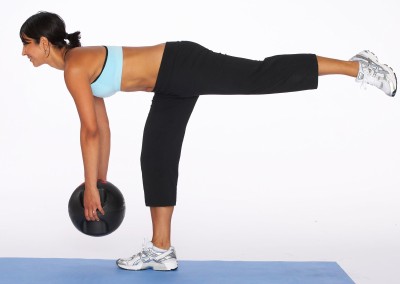
Your booty and your belly are unlikely partners in crime. Here's why: Over time, sitting around too much renders your glutes practically useless and causes your hip flexors—the muscles that connect your hipbones to your legs—to become stiff. This couch-potato combo tilts your pelvis forward, which increases the arch in your back and puts stress on your spine. From a cosmetic standpoint, it pushes your abdomen out, making even a relatively flat stomach bulge. That means that to lose your gut, you've got to work your butt. Exercises like the single-leg deadlift and hip-glute raise (see below) will help you get a stronger behind. Combat tight hip flexors with this stretch: In a lunge position, lower yourself so your back knee is resting on the floor. Push your hips forward, keeping your back upright, until you feel a stretch in the front of the hip. Hold for 10 seconds, relax, and repeat. Switch legs. You can increase the stretch by reaching your arms over your head.


RULE #3: Eat flat-belly foods.

You can't see ab muscles if they're buried under a layer of fat. Excavate them by following these easy dietary guidelines.

*Pump up your protein intake. Substituting meat, fish, dairy, and nuts for carbs can reduce the amount of fat around your middle. Researchers have discovered that when people exchange carbohydrates in favor of an equal amount of protein, they reduced overall belly fat.

*Eliminate added sugar. The average American eats about 20 teaspoons of sugar daily in the form of processed foods like soda, baked goods, breakfast cereals, fruit drinks, and even flavored yogurt. That's about 325 empty calories every day. All that sugar increases insulin production, which slows your metabolism.

*Don't fear fat. Research shows that diets containing more than 50 percent fat are just as effective for weight loss as those that are low in fat. Fat is filling and adds flavor to your meals—both of which help you avoid feeling deprived, so you can stick to your diet. Eat foods rich in monounsaturated fats, such as olives, nuts, and avocados; research has even found that it's OK to enjoy whole foods that contain saturated fat (including milk, cheese, and butter) in moderation.

*Beat the bloat. No matter how much ab fat you lose or muscle you tone, if you're bloated, you won't look (or feel!) your best in a swimsuit. Carbonated beverages, and even good-for-you foods such as beans and broccoli, can make your stomach swell. And keep your sodium intake in check: Nutritionists suggest you stay under 2,000 milligrams to avoid retaining excess water. (Most of us get closer to 5,000 a day.)

RULE #4: Stop stressing.

Your kids. Your in-laws. Your never-ending to-do list. I get it—life is hard. But anxiety can produce extra cortisol, a hormone that encourages the body to store fat, particularly in your belly. According to researchers, your midsection is four times as likely as the rest of your body to store stress-induced fat. Help keep anxiety in check by taking little breaks from work every 90 minutes. Another way stress sabotages your abs: When tension runs high, we reach for fattening foods. To keep your hand out of the office candy jar, keep it out of reach. In one study, participants who had to walk six feet to reach the candy ate up to seven fewer chocolates per day than when the jar was conveniently located at their desk.

RULE #5: Work your abs less often.

Ditch your daily ab workouts. You need only three sessions a week to see maximum results. Training every day with endless crunches won't flatten your belly faster. You'll see benefits quicker if you give your muscles a day to fully recover between workouts. That's because stressing your muscles during a workout breaks down the tissues, and they need rest days to rebuild and get stronger. What's more, you should stick to only 15 to 20 reps of each move. If you can easily do that many, it's time to for harder moves. And if flat abs are important to you, promote them to the top of your fitness to-do list. A lot of people exercise their abdominal muscles at the end of their workout, and that's when you get sloppy or run out of time. You should do them first, and then move on to your cardio. To get them looking great, you need to make them a priority. You'll be glad you did.

Sunday, October 25, 2009

Pump up, slim down


Tired of sweating all over every piece of cardio equipment at the gym and still getting zero love from the scale? You need more iron. And not in your diet—in your hands. According to the National Center for Health Statistics, a mere 21 percent of women strength train two or more times a week. What you don't know: When you skip the weight room, you lose out on the ultimate flab melter. Those two sessions a week can reduce overall body fat by about 3 percentage points in just 10 weeks, even if you don't cut a single calorie. That translates to as much as three inches total off your waist and hips. Even better, all that new muscle pays off in a long-term boost to your metabolism, which helps keep your body lean and sculpted. Suddenly, dumbbells sound like a smart idea. Need more convincing? Read on for more solid reasons why you should build flex time into your day.


Torch Calories 24/7. Though cardio burns more calories than strength training during those 30 sweaty minutes, pumping iron slashes more overall. A study in The Journal of Strength and Conditioning Research found that women who completed an hour-long strength-training workout burned an average of 100 more calories in the 24 hours afterward than they did when they hadn't lifted weights. At three sessions a week, that's 15,600 calories a year, or about four and a half pounds of fat—without having to move a muscle. What's more, increasing that afterburn is as easy as upping the weight on your bar. In a study in the journal Medicine & Science in Sports & Exercise, women burned nearly twice as many calories in the two hours after their workout when they lifted 85 percent of their max load for eight reps than when they did more reps (15) at a lower weight (45 percent of their max). There's a longer-term benefit to all that lifting, too: Muscle accounts for about a third of the average woman's weight, so it has a profound effect on her metabolism, says Kenneth Walsh, director of Boston University School of Medicine's Whitaker Cardiovascular Institute. Specifically, that effect is to burn extra calories, because muscle, unlike fat, is metabolically active. In English: Muscle chews up calories even when you're not in the gym. Replace 10 pounds of fat with 10 pounds of lean muscle and you'll burn an additional 200 calories a day without even trying.


Target Your Trouble Spots. If you've ever tried to ditch the saddlebags and ended up a bra size smaller instead, you know that where you lose is as important as how much. As great as it might be to see the numbers on the scale go down, when you're on a strict cardio-only program your victory is likely to be empty. A recent study at the University of Alabama at Birmingham compared dieters who lifted three times a week with those who did aerobic exercise for the same amount of time. Both groups ate the same number of calories, and both lost the same amount—26 pounds—but the lifters lost pure chub, while about 8 percent of the aerobicizers' drop came from valuable muscle. Researchers have also found that lifting weights is better than cardio at whittling intra-abdominal fat—the Buddha-belly kind that's associated with diseases from diabetes to cancer. Just don't rely exclusively on the scale to track your progress in the battle of the bulge. Because muscle is denser than fat, it squeezes the same amount of weight into less space. "Often, our clients' scales won't drop as fast, but they'll fit into smaller jeans," says Rachel Cosgrove, owner of Results Fitness in Santa Clarita, California. And it's the number on the tag inside your bootcuts you want to get lower, right?


Start Pumping. Begin with three weight-training sessions each week. For the greatest calorie burn, aim for total-body workouts that target your arms, abs, legs, and back, and go for moves that will zap several different muscle groups at a time—for example, squats, which call on muscles in both the front and back of your legs, as opposed to leg extensions, which isolate the quads. For each exercise you do, try to perform three sets of 10 to 12 reps with a weight heavy enough that by your last rep you can't eke out another one without compromising your form. To spark further muscle building, William Kraemer, Ph.D., a professor of kinesiology at the University of Connecticut, suggests alternating moderate-intensity workouts of 8 to 10 reps with lighter-weight 12- to 15-rep sets and super-hard 3- to 5-rep sets. And remember to fuel your workout properly. Too many dieters make the fatal error of cutting back on crucial muscle-maintaining protein when they want to slash their overall calorie intake. The counterproductive result: They lose muscle along with any fat that might have melted away. Sports nutritionist Cassandra Forsythe, Ph.D., co-author of The New Rules of Lifting for Women, recommends that you eat one gram of protein for every pound of your body weight that does not come from fat. For instance, a 140-pound woman whose body fat is 25 percent would need 105 grams of high-quality protein. That's roughly four servings a day; the best sources are chicken or other lean meats, soy products, and eggs. Ready to turn yourself into a lean, mean, calorie-torching machine? Then go get pumped!
Source: Womens Health

Sunday, October 11, 2009

7 Secrets to Highly Successful Weight Loss


Your weight-loss strategy should be similarly inspired. Find someone who inspires you and find out what they do to look so good. Or follow the tips below. Willpower alone won't shrink your waist—you need facts on your side if you're going to maintain the resolve you showed last January. Luckily, there are scientists who study weight loss and regularly come up with good advice, the latest and greatest of which I've gathered for you here. Your new body starts now. Bonus tip: It’s never too late to get back in shape.

Weigh yourself. Often experts used to suggest staying off the scale—it can be discouraging. But after studying 3,500 individuals from the National Weight Control Registry (NWCR) who've maintained 60 or more pounds of weight loss for at least a year, researchers found that 44 percent weighed themselves daily. "They use it as an early warning system for preventing weight regain," says James Hill, Ph.D., NWCR cofounder and director of the Center for Human Nutrition at the University of Colorado.

Beware of tastebud betrayal. "Hunger increases taste sensitivity to sweet and salty substances," says researcher Yuriy Zverev, of the University of Malawi. This means vending-machine snacks (which come in two flavors: sweet or salty—coincidence?) will taste even better when you're hungry. You could trust that you'd savor the flavor by eating only a small amount. (Right.) Or you could sidestep this land mine altogether. "Eat offensively," says Katherine Tallmadge, M.A., R.D., a spokeswoman for the American Dietetic Association. "Eat regularly during the day to stave off cravings and the bingeing that can result." Bonus tip: You don’t have to abandon all of your indulges to lose weight and keep it off.

Turn off the TV. Scientists at Brookhaven National Laboratory in New York recently determined that simply seeing food can trigger a physiological "feed me" response. In the study, visual food cues caused brain activity to jump by 24 percent—mostly in the orbitofrontal cortex, the area of the brain related to drive and acquisition. So a constant barrage of pizza-delivery ads on TV could test your limits. And don't get me started on the Food Network.

Snack on almonds.
Seventy per day, to be exact. That's the number that people in a City of Hope National Medical Center experiment ate daily for six months, in conjunction with a reduced-calorie diet, to drop 18 percent of their body weight. Study author Michelle Wien partially credits the satiety factor. "Almonds are a nutrient-dense food that provides healthful monounsaturated fat, protein and fiber, which together contribute to feeling full," she says. Go for whole almonds in their unsalted, raw or dry-roasted state. Fifteen to 20 will do the trick for a quick snack. Try 50 as a meal replacement.

Go under the needle. When Polish researchers examined acupuncture as a diet aid, they found that people who got needled lost 10 more pounds and ticked 2 additional points off their BMIs compared with those who merely cut calories. Marie Cargill, a licensed acupuncturist in the Boston area, explains that pressure points on the body—mostly on the ear—work as a switchboard to the brain, triggering electrical pulses that suppress appetite. "The ear system is very effective for addiction treatment," she says.

Pour a bowl of cereal for lunch. A study from Purdue University shows that eating cereal in place of meals helps you lose weight. Participants consumed an average of 640 fewer total daily calories and lost roughly 4 pounds during the two-week intervention. According to study author Richard Mattes, M.P.H., Ph.D., R.D., the approach teaches portion control with a convenient, easy-to-use food. Important though-stick to filling, high-fiber cereals, like All-Bran or Fiber One, and eat them with low-fat milk.

Eat a cow's worth. Of dairy, that is. Reports of the benefits just keep coming. Recently, a University of Tennessee study found that people who ate a daily 1,200 milligrams (mg) of calcium from dairy lost an average of 24 pounds, or 11 percent of their total body weight. "When you don't have enough calcium in your diet, you're more efficient at making fat and less efficient at breaking down fat, causing a bigger, fatter fat cell," says lead researcher Michael Zemel, Ph.D. Get the just-right amount by taking in two 8-ounce glasses of low-fat milk (699 mg), a cup of low-fat yogurt (338 mg) and an ounce and a half of cheese (287 mg).

Gamble on yourself. Take a cue from the poker craze and wager against a friend to see who can shed the most pounds. "Men especially do really well when they make weight loss a competitive game," says New York City nutritionist Joy Bauer, M.S., R.D., author of Cooking with Joy. "Have a six-month and a one-year check-in—none of that two-week garbage."

Source: MSN "7 Secrets to Highly Successful Weight Loss" (Sept 30, 2009)

Sunday, August 23, 2009

Hot Fitness Trends for 2009

If you're wondering what are the hottest trends in fitness this year or even just wanting to "change it up" a bit, here's some fantastic ideas that will be sure to make you sweat, burn some calories, and tone your muscle! The list I found is from ACE (American Council of Exercise) and ranks 1 to 10.

1. Boot camp-style fitness programs. Haven't tried it? Look up a bootcamp in your area and give it a try-you're bound to burn 600 calories in ONE class!


2. Workout plans that are less expensive. (With the economy and all.)
3. Specialty classes like Zumba, Bollywood, Afro-Cuban, and ballroom dancing. These classes are set to rhythmic music and aim to increase cardiovascular fitness while folks have fun.


4. The basics. Fitness professionals believe that people will want to return to basic fitness programs.
5. Circuit training. Circuit training blends strength training and cardiovascular activity at different intensities. Another plus: gyms can set up their own circuit for members to follow.


6. Kettlebell training. These iron weights, traditionally used in Russia, aim to develop whole body fitness and core strength. A fun twist to strength training!


7. Boomer fitness. A focus on fitness led by people 50 and older.
8. Technology-based fitness. Using high-tech gadgets like iPods to help keep workouts engaging, plus an increase in interactive fitness video games.


9. Event or sports-specific exercises. A focus on the simple things, like basketball or volleyball games, or day bike rides. Even triathlons!


10. Mixing it up. Low-intensity cardio or weight training on one day, followed by a high-intensity workout on another day

Sunday, August 16, 2009

How to Resist Temptation


In a world where you can inhale half of your daily caloric intake as you exit the drive-thru, often the only thing standing between you and a few extra chins is willpower-that oh-so-elusive ability to stop the urge to indulge. If your powers of resistance are lacking, you'll be glad to hear that research actually shows that willpower is a kind of mental muscle, and like any muscle, it can get stronger. These four tactics target the most common resolve busters. Put them into practice, and pretty soon that jelly glazed doughnut or that triple fudge brownie will be no match for your mental strength.

Rule #1: Eat smaller, more frequent meals
What it targets: Out-of-control hunger
Why it works: Going too long without eating makes your blood sugar levels plummet. That leaves you feeling ravenous and with an appetite that can overpower any sense of logic or best intentions to eat well. If you have small meals every 3 hours, your blood sugar remains stable, preventing the wallop of a sugar low that will leave you vulnerable to overeating. Did you know that that your blood sugar levels do more than affect how hungry you get? They're also directly connected to willpower. So, reach for snacks in between meals that balance carbohydrates with protein like low-fat yogurt and berries or an apple and a handful of almonds. When you do this, you will keep blood sugars at bay and stay fuller longer.

Rule #2: Eat with your other hand
What it targets: Distraction or eating too quickly
Why it works: Picking up a fork with the hand you don't usually use while eating slows you down and makes you focus on your meal and eat at a slower pace, two things that have been proven to aid weight loss. Studies have shown that that with regular practice, this kind of switcheroo can also increase your overall willpower. Also, by eating slower, your brain is able to tell your stomach when you're satisfied and you'll end up eating less.

Rule #3: Weigh yourself regularly
What it targets: Losing sight of your goal
Why it works: Few things keep your weight loss goal front and center better than seeing those big glowing numbers on the scale. Regular weigh-ins also make it easier to notice extra pounds creeping on, so you can slash and burn immediately. Researchers have found in studies that those that weighed themselves frequently, daily or weekly, lost more weight than those that didn't. Actually, about DOUBLE the amount of weight of those that didn't step on the scale often. But keep in mind, that your weight is going to fluctuate to some degree. Your clothing, the time of day, and how much water you're retaining all affect your weight, so don't be discouraged if that number goes up a few pounds suddenly. Also, break your goal weight into several smaller targets-first aim for five pounds, then after you hit that, go for another five. Studies have shown that the more frequent and specific your weight loss objectives, the better your chances to sticking to them.

Rule #4: Lift your spirits
What it targets: Emotional eating
Why it works: It's estimated that when people overeat, nearly 75% of the time it's because they're feeling blue. It stands to reason that lifting your spirits might also help you take your mind off munching. Studies have shown that small doses of pleasant emotions can quickly renew your ability to say no. So, go do something you enjoy, go for a walk outside, talk on the phone, read...just find something to do that you enjoy and makes you happy-it might be temporary, but it will help sustain your urge to splurge.

Source: Women's Health

Monday, June 8, 2009

How to lose "that last 10 lbs"


I know, I've dropped off the face of the planet. So, if I still have readers out there, I sincerley apologize for letting you down with a lack of posts lately. As soon as May came, I knew it was going to be harder, especially with my boot camp I run all summer long. In between that, there's kids, husband, house, yard, activities, church responsibilities, oh, and my other blog to manage (as I'm sure you all can relate to). Trying to get 2 posts/week might be hard with summer, so I'm going to do my best to post once a week, most likely Sun or Mon for the next few months. And also, if you have any ideas or questions for this blog, post them! I love to hear your ideas so I can answer your questions (most likely you're not the only one wondering).

Lately, I've been asked..."how do I lose that last 5-10 lbs"? While it's true that those pounds are the hardest to lose, it can happen with a few of these tricks below.

1. Do more intense cardio. Your metabolism tends to naturally slow a bit as you lose weight. To offset the sluggishness, try increasing the intensity, but not the length, of your workouts. This appears to be more effective for burning calories and boosting your metabolic rate than increasing the amount of time you put in. If you've been walking at a moderate pace for 30 minutes, for example, try doing 2-3 min of intervals of walking and jogging.

2. Change your strength-training routine. Toning exercises are another great way to increase metabolism. That's because muscle burns at least four times more calories than fat—so the more muscle you have, the leaner you'll be. I recommend doing at least 30 minutes of strength training, twice a week. (My boot camp is a great way to change up your routine and challenge your body! Or find one in your local area.) But there's one more key: you have to continually challenge your body to keep getting results. If you've been doing your own never-changing workout for months, it's time to give your body a push. Try learning some new exercises, using heavier dumbbells, adding plyometrics, and combining mutliple muscle groups together in one exercise.

3. Eat a little less. One of the things I hear all the time is, "I haven't changed a thing, but suddenly I'm not losing weight." And I say, "Yup, that's exactly why!" Women often forget that the smaller their body, the fewer calories it requires. Say, for example, you started off weighing 165; you'd need about 2,475 calories a day to maintain your weight. (That's if you exercise most days of the week. You'd need less if you're not as active.) If you get down to 140 pounds, you'll need only about 2,100 calories—375 fewer calories a day. To figure out your calorie needs, multiply your current weight by 15; that's roughly the number of calories you need each day to maintain your weight if you're not exercising regularly. To keep losing, you'll need to eat less or exercise more—or both.

4. Reevaluate your goal weight. A lot of us have a magic number in our heads—and sometimes, sorry to say, it's not attainable or even healthy. You might be struggling because you really shouldn't be 130 pounds. Maybe 140 is the right weight for you. Make sure your goal is a sensible one (a BMI calculator can tell you the best weight for your height). You may realize that you've been at your healthiest scale number all this time.

5. Give yourself more time. Some women are realistic about how many pounds they should drop, but they often don't know how long it should take to lose them. In a recent study, for example, women who weighed 200 pounds wanted to get to 140—a reasonable, healthy weight for their height. But they wanted to get there in just two months. Experts agree that to lose that many pounds in a healthy, keep-it-off kind of way, most women would need at least six months. Stick with your healthy habits and be patient—you will get there.

6. Watch what you're sipping. A large Mango-A-Go-Go smoothie at Jamba Juice, for example, has 660 calories; a 16-ounce Starbucks Strawberries & Creme Frappucino has 580 calories. It's no wonder that research shows that a majority of the extra calories Americans get come from what we drink—not what we eat. Regular sodas, fruit drinks, high-cal blended coffees and smoothies can pile on hundreds of calories a day. That's enough to stop weight loss and cause you to get stuck at your current weight—or even lead to weight gain. Try sticking to water or seltzer mixed with a splash of fruit juice.


7. Get support.
The weight loss journey is like running a marathon. Those last few pounds are the most frustrating and slow to come off, and it's the most likely time for people to give up. If you don't have people cheering you on during the last bit of it, you'll be less likely to cross the finish line. In fact, a recent study found that participants needed extra support during the last six months of a weight loss program in order to keep losing. So get yourself a pep squad. Find a workout buddy. Join a boot camp. :) Or have your best friend, mom or hubby check in with you every few days to give you some you're-almost-there encouragement.

Thursday, April 23, 2009

Fitness IQ Test Answered

1. C. Strength training. Your BMR (Basal Metabolic Rate) is the number of calories you burn during the day at rest, meaning if you laid in bed all day, this is how many calories you would burn. For most women, this number is between 1200-1600 calories/day. (The best way to find this number is to get tested.) This is an average of course, and obviously will vary. The higher your muscle mass ratio, the higher your BMR is (which is a good thing!). The only way to increase this number is to add muscle. And the only exercise that can add muscle is strength or resistance training. For every 1 lb. of muscle added, add 50 calories to your BMR. That’s more calories you burn everyday doing NOTHING!!!

2. FALSE. A common misconception is that in order to burn fat, you need to stay within the lower range of your Target Heart Rate zone (THR). In fact, any heart rate WITHIN your THR will burn fat. Why? Because the THR is your “aerobic” zone, meaning your muscles are working in an oxygen-rich environment, which is conducive to burning fat. Anything below that range isn’t considered aerobic, and above that range is anaerobic, at which point you are utilizing lactic acid. While it is good to have spurts of intense, huffing and puffing intervals of anaerobic exercise, you don’t want to have an ENTIRE workout in the anaerobic zone. Basically, you want BOTH your heart rate and breathing to be elevated. Here’s how we will figure out YOUR THR.
Take 220-your age=age-adjusted maximal heart rate (220-31 (my age)=189)
Figure out 65% of that number (Multiply 189 X .65=123)-low end of THR
Figure out 85% of that number (Multiply 189 X .85=160)-high end of THR

3. B. How high your heart rate is. A little bit of a trick question. Notice I emphasized BEST. While the other answers can be an indication of how hard you’re working, nothing is better than knowing what your HR is. Why do you think this is the most effective way to know how hard you’re pushing yourself? Because sometimes going by our “Perceived Exertion” isn’t always accurate. How much we’re sweating, how hard we’re breathing, or how fatigued we feel don’t always tell us WHERE we are working along the THR. Just as talked about in the last question. If we don’t own a HR monitor (which I highly recommend buying one-they’re not expensive), we can perform this self-check every 5 min by finding our pulse on our wrist or neck, timing it for 10 sec and multiplying that number by 6.

4. FALSE. Here’s a BIG misconception. Women do not have near the levels of testosterone that men do to build muscle. We aren’t genetically programmed to do that and would have to take anabolic steroids to see any serious amount of muscle mass built. The reason many women feel they appear “bulky” from lifting weights is because they have an extra layer of fat over their muscle! Shed the fat, and what do you see? A lean, mean muscle machine!

5. FALSE. Another big myth. Many people believe that the energy boost you get from exercise is a double-edged sword. It’s a great pick-me-up in the morning, but if you work out at night, you may not sleep well. If this was gospel truth, morning people would rule the world! Fortunately for night owls, there is no one best time to exercise. It’s a matter of what you prefer. Fitting exercise into your daily routine is the main issue. Just remember to wait at least 2 hours after eating before working out. And no, working out is unlikely to keep you up at night. As long as you don’t exercise too close to bedtime, you will probably sleep better on the days you work out.

6. E. All of the above. While many think running is the best way to lose weight, this isn’t necessarily true. It doesn’t matter what type of exercise you do. Of course, different exercises might burn more calories than others, but it’s all about intensity here. It might not take much to get your HR elevated up running, but maybe biking it takes a little more effort? Well, then work intervals into your routine-short bursts of speed, hills, or an increase in resistance to get that HR up! Just remember, it’s all about intensity, duration, and frequency. And the bottom line is, you have to ENJOY IT! If you’re not a runner and hate doing it, then why force yourself to do something you dread? It’s best to find activities we prefer, so we can stick to them and maintain healthy lifestyle habits!

7. FALSE. This is a big misconception and something I hear a lot, especially from women over 30! “It just seems like it’s so much harder to lose the weight now!” We’ve all heard or thought this before, right? So, why isn’t this true? The solution is going back to increasing our metabolisms, our BMR’s. While it is true that we start to lose muscle after age 30, that doesn’t mean we can’t stop it or reverse the effects of this! If we add a little muscle mass by strength training (which will also be good for our bones as we age!), continue exercising, and watch we eat, then we are not DOOMED and we can look younger and FABULOUS!

8. FALSE. You might not want to hear this, but you could do all the crunches and stomach exercises EVERYDAY and not see any results. While these exercises are great to strengthen and tone our abdominal exercises, they can’t get rid of the fat. To burn fat and flatten your belly, you need to burn more calories. Once you’ve gotten rid of the fat, your washboard abs will become more visible.

9. D. Any of the above can get results. Another trick question! We hear so many different answers to this one, don’t we? This can be very confusing to those trying to lose weight! How much effort do we really need to put in to see results? The answer is anything! Now, while devoting 2 hrs a day 5-6 days a week might deliver results FASTER, it doesn’t mean that’s what is required to lose weight. The key is consistency and the bottom line is CALORIES IN VS. CALORIES OUT. If we can’t or don’t want to devote too much time to exercise, then just focus more on the nutrition (which is 80% of it anyways). I’ve had clients before that did the minimum (3 days a week) and still lost lots of weight, mostly because of their eating habits!

10. TRUE. While this is actually true, it’s also only temporary. Just keep at it and periodically (every 2 to 3 weeks) “up the ante” by changing the frequency, duration, intensity, even type of exercise you’re doing. You should continue to see results if you continue to challenge yourself.

11. FALSE. Not necessarily. You should be working at your predetermined THR. If you exercise too hard and fast, you may be burning fewer calories than in less intense, aerobic workouts. This goes back to when we talked about our THR or aerobic zone, and the anaerobic zone. Again, this doesn’t mean we shouldn’t ever go outside and above our aerobic zone, but that we should keep those bursts of high-intensity exercise limited to a few intervals in each workout. (And it’s also good to go into this anaerobic zone because this is how we increase our heart rate zone and capacity to utilize oxygen!)

12. FALSE. Unfortunately, there's no way to “spot reduce” certain areas. Yes, it’s beneficial to do exercises that target our problem areas, but we should be doing compound exercises that utilize more than those exercises so we can increase our heart rate and burn more calories (and maximize our time!). And going back to the question about getting a 6-pack, it’s all about getting rid of the overlying fat, so we can see those muscles!

Sunday, April 19, 2009

Test your Fitness IQ

Take this test. The answers and explanations will be given in a few days! Good luck!


1. You can increase your metabolism, Basal Metabolic Rate (BMR) by:
A. Running
B. Biking
C. Strength training
D. Any form of exercise


2. TRUE or FALSE If you want to burn fat, it is best to stay in the “fat-burning zone” of your Target Heart Rate (the lower end of your THR) and not the “cardio zone” (the higher end of your THR).

3. The best way to know how hard you are pushing yourself during exercise is by:
A. How tired or sore you are
B. How high your heart rate is
C. How much you’re sweating
D. How hard you’re breathing
E. All of the above


4. TRUE or FALSE Lifting HEAVY weights (strength training) frequently can cause women to get “bulky” and build too much muscle mass.

5. TRUE or FALSE The best time to work out is early in the morning.

6. The best exercise for losing weight is:
A. Running
B. Biking
C. Eliptical/Cross-trainer
D. Strength training
E. All of the above


7. TRUE or FALSE As you age, you lode muscle and gain fat, thereby decreasing your metabolism, no matter what you do.


8. TRUE or FALSE To get ripped abs or a “6-pack”, you should do crunches every day.


9. How much exercise time is needed to lose weight, improve cardiovascular endurance and function, and see results?
A. 3 days a week for 30 min/session
B. 5-6 days a week for 2 hrs/session
C. 3-5 days a week for 60 min/session
D. Any of the above can get results


10. TRUE or FALSE Eventually, your weight and fitness level will plateau.


11. TRUE or FALSE The more intense your work out, the more fat you burn.


12. TRUE or FALSE To get rid of the “arm jiggle”, the “saddle-bags”, the “love-handles”, or the “inner thigh fat”, you must do specific exercises to target those muscle groups/areas in order for them to go away .

Thursday, March 12, 2009

The best ways to cut 100, 250, and 500+ calories (WITHOUT DIETING!)

SAVE 100+ CALORIES:


1. Add the olive oil last. Instead of sauteing vegetables and letting them soak up the majority of the fat that's added to the pan, try steaming your veggies instead, then tossing them with a few teaspoons of extra-virgin olive oil, a squeeze of lemon, and a pinch of red pepper flakes and sea salt. Calories saved per cup: 150

2. Ask for a "dry" bun. Chefs and cooks often swipe a knifeful of butter or mayo on a sandwich or burger before they hand it over to you. Calories saved: 120

3. Be picky about pie. Eat the filling but skip the bottom layer of crust. Trust me, you won't really notice. Calories saved: 150

4. Lighten your juice. Fill a water bottle with 6 ounces of juice and equal amount of water. Calories saved: 100

5. Make skinny mashed potatoes. Mix in a half of cup of low-sodium chicken broth for every 3 lbs of potatoes instead of half a cup of butter or heavy cream. If you still crave that rich flavor, top a small scoop of mashed potatoes with a pat of butter for just 36 extra calories. Calories saved per cup: 150

6. Use half the beef in burgers. Mix 1 1/2 cups of finely chopped mushrooms with half a pound of lean ground beef and serve it in place of an all beef patty. Calories saved: 100

7. Switch your soup. Varieties of soup that are a cream or milk based contain 25 to 50% more calories than those made with a tomato base or clear broth, such as minetrone or vegetable soup. Calories saves per 12 oz: 100 to 200

SAVE 250+ CALORIES:


1. Avoid salads with "crispy" in their name. Some options pack more than 500 calories and 25 grams of fat when tossed with regular dressing. Order your greens with grilled chicken, shrimp, or salmon and lowfat dressing. Calories saved: 250

2. Downsize yoru baked goods. You can automatically halve the calories in fresh-baked muffins by using a pan with a dozen slots rather than one with just six. And if you swap half a cup of applesauce for the half cup of butter or oil called for in your recipe, you can save an additional 75 calories per muffin. Calories saved: 310 to 385.

3. Get sandwich-savvy. A 6-inch tuna hero with lowfat chips may seem like a light meal, but it contains 700 calories and more than 30 grams of fat. At "healthy" restaurants, people tend to order extras and then underestimate how much they're eating by about 35%. Opt for a small turkey sub without mayo or oil and skip the soda, chips, and cookies. Calories saved: 420

4. Top your tater the light way. Loading a large potato with the works can turn your meal into a fat and calorie mine-field. Pick a small spud (red potatoes are best) and fill it with a quarter cup each of salsa and lowfat Greek yogurt (or 1 Tbs of reduced-fat sour cream). Calories saved: 412

5. Treat yourself like a kid. When you're ordering ice cream, don't assume you have to choose from the three cup sizes displayed at the register. Rather than ordering the medium, request a child-size verstion-and skip the hot fudge. Calories saved: 400

6. Bulk up your pasta-with veggies. If you're making pasta at home, a 2-cup serving of noodles with a large ladle of meat, vodka, or Alfredo sauce can set you back 600 calories or more. To fill your plate-without breaking the calorie bank-mix a cup of pasta with a cup of steamed veggies and top the dish with half a cup of your favorite marinara sauce. Calories saved: 250

7. Serve dessert in a shot glass. Can't resist taking a slice of key lime pie or cheesecake at a buffet? Allow yourself to savor the amount that fits in a shot glass and you'll save 80% of the calories you'd get in a full-size portion. Calories saved: 360

8. Choose wisely at breakfast meetings. When fresh fruit salad or lowfat yogurt isn't an option, you can still slash hundreds of calories by savoring four powdered sugar or glazed doughnut holes rather than that nutritious-sounding but humongous banana-walnut muffin. Calories saved: 280


SAVE 500+ CALORIES:


1. Take your own popcorn to the movies. A medium container of popcorn from the theater has at least 900 calories-NOT including the butter topping. Pre-pop your lowfat favorite popcorn from home and stash the bag in your tote. Calories saved: 600

2. Ditch designer cereals and granolas. Muti-grain and all-natural cereal options can still be high in sugar and fat. Go for fiber-rich cereals that contain 200 or fewer calories per cup (oatmeal would be a good option and will keep you feeling full). Calories saved: 500

3. Avoid meat lover's pizza specials. Order a fully loaded veggie pizza and you'll get half a serving of fiber-rich produce on every slice without all the calories from sausage, bacon, and pepperoni. To cut calories further, order your pizza with a thin crust rather than the deep-dish style and get half cheese. Calories saved per two slices: 500

4. Choose a leaner cut of meat. When dining at a restaurant, order a 6-ounce filet mignon rather than the 8 or 12-ounce T-bone or prime rib. Also, ask the chef to not brush the steak with butter or oil (they do this to make it look juicer) to save an extra 100 calories. Calories saved: 500 to 600

5. Turn your back on the buffet table. Pick a spot that's at least 16 feet fromt he smorgasbord and face away from the food when eating. A study conducted shows that people who did this ate several hundred fewer calories, on average, than those who sat just a few feet away facing the table. Calories saved: 650

Source: SHAPE Magazine

Sunday, March 1, 2009

9 fitness rules you should break

Each year fitness researchers release thousands of studies that challenge conventional fitness thinking, or at least shed light on ways to tweak it. Here are 9 "old-school" fitness approaches or strategies and some ways to tweak them to be up-to-date and to see results!

1. Position your hands shoulder-width apart.
You often see this in instructions for upper-body moves like bench presses and lat pull-downs. Why? Because it gives you a stable starting point. But that doesn't mean you need to stay there set after set. Switch up your position after every set for balanced strength and overall tone.

2. Crunches for a flat belly.
Turns out Pilates abdominal moves are superior to traditional crunches for sculpting your midsection and uncovering those abs. An exercise called "the teaser" is one of many highly effective exercises. It activates 39% more of your rectus abdominus muscle and 266% more of your external obliques. To do it: Lie face-up on a mat. Lift your legs so your thighs are perpendicular to the floor and your knees are bent 90 degrees. Raise your hands toward the celing. Lift your torso and straighten your legs, so you body forms a V. Hold for 1 second, then roll back down, keeping your legs raised. Perform 20-30 reps.

3. Squats=a perfect bum.
Although squats are a great exercise, try doing hip extensions too. The move hits 55% more of your hamstring muscle and 79% more of your glute muscle. To do it: Get on your hands and knees. Keeping your knees bent, lift your right heel toward the ceiling, then lower it back down to the starting position. Perform 15-25 reps each leg.

4. Eat lots of extra protein for less jiggle and more tone.
While it's true that protein is a vital muscle food, your body can use only so much of it. Any extra protein calories you take in will be stored as fat. As a general rule, remember that 20% of your calories should come from protein. So, if you're eating an 1,800 calorie diet, try to shoot fora maximum of 400 calories, or 90 grams, of protein each day.

5. Up-down-up-down. Repeat.
Instead of raising and lowering a weight (or your body weight) in one continuous motioin, pause for a second about halfway up, continue the movement, then pause again about halfway down. You'll fry more fat (by exhausting the muscles more efficiently) without sucking more time out of your scheudule.

6. Watch yourself in the mirror while you workout.
While the occasional glance at your reflection to check form is a good idea, for exercises that involve balance, such as the one-legged squat, you'll get a bigger boost if you face away from the mirror and close one eye. Doing so activates neural pathways between your brain and your muscles that you don't otherwise use, which forces your body to establish better balance.

7. Burn the most calories with cardio.
According to many studies, 30 minutes of weight training burns as many calories as running at a blazing six-minute-per-mile pace for the same amount of time. (And it has the bonus of building more muscle tone then running.) What's more, unlike aerobic exercise, lifting weights has been shown to boost metabolism for up to 39 hours after you finish your last rep! Interval training has yielded similar benefits. For optimal results, do a total-body weight-training workout three days a weeks, resting at least a day between sessions and do intervals on at least tow fo the off days.

8. Rest between sets.
Less rest increases your calorie burn and adds a cardio component to strength training. Try doing multiple exercises back to back (circuit training) using different muscle groups and combining large muscles and small muscles in as many exercises as possible. When you have completed a circuit, rest for a minute and then repeat.

9. Weigh yourself daily for motivation.
The scale measures water and muscle, too. It's not a great indicator of fat loss. A better way to measure success is by measuring inches or getting your body fat tested, say every month to see progress.

Source: Womens Health

Sunday, February 22, 2009

Wanna burn 500 calories???

THE BIGGEST CALORIE-BURNING EXERCISES:
Calories burned per hour*
Based on a 160-pound person

986 calories burned: Running at 8mph
913 calories burned: Rollerblading
730 calories burned: Tae Kwon Do
730 calories burned: Jump rope
657 calories burned: Stair treadmill
584 calories burned: Jogging at 5mph, cycling at 18mph
511 calories burned: Backpacking, hiking uphill
511 calories burned: Racquetball. mountain biking
511 calories burned: Cross-country skiing, indoor cycling class
511 calories burned: High-impact aerobics, high intensity weight/circuit training
* Values from the Mayo Clinic Exercise for Weight Loss chart

Of course, these values are estimates, and actual calorie expenditure will not be the same for everyone. Your mileage may vary (so to speak) depending on many factors, such as the intensity of your workout, your weight (and more importantly body fat %) and your current fitness level.

Sunday, February 15, 2009

6 surprising reasons you're not losing weight


Here's some POSSIBLE reasons you're sabotaging your slim-down efforts, and how to get back on track.

1. You're LOADING up on whole grains. Let's be honest-while whole grain versions are a good replacement for the white flour variety, many of these snacks can still be high in fat, sugar, and sodium, not to mention CALORIES. People who eat the greatest number of servings of MINIMALLY processed whole-grain foods-not snack foods, like crackers, cookies, or chips-enjoy the biggest weight-controlled benefits. Solution: Aim to increase your intake of brown and wild rice, oatmeal, and other whole-grain cereals and breads. Not only do these foods contain fiber, which helps curb your appetite, but they're also low on the glycemic index (meaning they are absorbed in your bloodstream slower allowing you to go longer without feeling hungry).

2. You allow yourself a "CHEAT" day...or TWO. You've probably learned from experience that denying yourself all treats when you're dieting can set you up for a binge. Your solution? Being "good" during the week and allowing yourself to splurge on weekends. While this may seem like a moderate approach to weight loss, it's still a feast-or-famine mentality that can easily backfire. Dieters shed a small amount of weight each weekday gained most of it back between Friday night and Monday morning! Solution: When it comes to shedding pounds, consistency is KEY. In other words, you'll be more successful if you allow yourself a 150-to 200 calorie treat a few times a week, rather than waiting until Friday night to splurge.

3. You make your own meals. There's little dispute that frequently eating out can wreak havoc on a diet. That may be true, but if you're not vigilant about certain things like, not picking at food while you cook (a BIG one), adding just a bit of extra butter or oil, using a heavy hand with dressings and sauces, and nibbling leftovers as you're clearing the table can tack on hundreds of calories to an otherwise healthy meal. Solution: Pull out your measuring cups and spoons and use them throughout the entire cooking process. A food scale can help you weigh items that can't be measured in cups, like poultry, fish, and cheese. To keep from snacking or tasting your meal, try chewing gum or sucking on a mint! Lastly, when you're ready to eat, take a small portion of food and put it on a salad plate rather than a dinner plate. Then, put the rest of the meal into single-serving storage containers. Popping them directly into the fridge or freezer will deter you from polishing off a second dinner soon after finishing your first.

4. You squeeze in workouts. No matter how tired you are in the morning or after work, you still push through your cardio session. Better to burn a few calories than none at all, right? Not necessarily. If you're truly feeling exhausted, it's more beneficial to ditch your workout and allow yourself an extra hour of shut-eye. Why? When you're sleep-deprived, your hormone levels change, stimulating cravings for starches and sweets. Your willpower diminishes too. Solution: Few of us can get eight hours of sleep and have the time for an hour-long workout, so get seven hours of sleep and schedule your workout earlier in the day, as exercising within four hours of bedtime may hinder your ability to fall asleep.

5. You eat slowly, savoring every bite. While this works alone, lingering in a group situation seems to have the opposite effect. Studies have shown that people take in 40 to 70 percent more calories when dining with family and friends. Solution: When dining out with friends, have a dining strategy in place so you don't have to think about the calories at the table. For example, decide whether you'll have a slice of bread or a drink. You might also order an appetizer as your main dish instead of an entree. You want dessert? Skip the bread, pick a lighter meal like a salad and split a dessert with a friend.

6. You enlisted a friend to help. Teaming up with a buddy seems more fun than dieting alone, which is why you talked your best friend into joining that weight-loss program with you. Unfortanately, her uneuthusiastic attitude can take a toll on your goals. People who make the most successful weight-loss partners are those whoe are committed to losing 10 percent of their body weight and plan to stick with the program for a set period of time. Bottom line is if you have to convince a friend to join you in a diet or exercise regime, she probably isn't ready. Solution: You may be better off going it alone or finding someone who can pull her own weight.

Tuesday, December 2, 2008

Healthy weight loss goals

One of my readers asked me what was a good healthy weight loss goal/week. The answer: 1-2 lbs/week. We're talking BODY FAT here (which is what you're trying to lose, right?), not muscle mass or water weight. If you do the math, to lose (or gain, for that matter) 1 lb. of body fat, you have to consume 3500 calories LESS than what you put out (opposite to gain). If you divide 3500 into 7 days/week, that comes out to 500 calories/day! For example, if you normally eat 2,000 calories a day without exercising and you're MAINTAINING your weight, than you will need to eat approx. 1500 cal/day in a weeks span to lose 1 lb. of body fat. If you add exercise in and burn 500 cal/hr, 5 days a week, then you'll lose a little more than that (unless you're eating more). Make sense?

It's all about calories in vs. calories out. When you see these diets where people are losing 7 lbs/week, let's face it, it's not all body fat. If you do the numbers, that would look like nearly 25,000 calories/week that they're burning (impossible unless you're expending calories like Lance Armstrong or Michael Phelps and spend hrs a day burning loads of calories!) And let's face it, although that would be nice, I GUARANTEE if you're losing more than 1-2 lbs/week, you're going to gain it back because that's water weight! So, if you're looking for real weight loss, steady wins the race!

Thursday, September 11, 2008

10 Small Tricks for Big Weight Loss

1. Drink more milk. Consuming 1,800 milligrams of calcium a day could block the absorption of about 80 calories.

2. Get watered down. Drink 100 oz of water a day. You will obviously be well hydrated (and less bloated), but you will also eat less.

3. Go smaller. Use a salad plate instead of a dinner plate. Studies shown that putting your portions on smaller dishes means you will end up eating less at a meal.

4. Think about eating. Eat without doing anything else-no TV, no working, no reading. It's important to chew slowly too, think about each bite, what it tastes like, etc. You will end up eating less.

5. Don't drink your calories. Usually those are "empty calories", however, if you must have the occassional cup of juice, dilute it water or drink V8 (Diet Splash is best) to get your vitamins/minerals.

6. Stop mindless snacking. Chew a strong flavored gum like cinnamon while you're cooking. Sneaking a taste of the food will be less appealing.

7. Tighten your belt a notch. It may sound silly, but by doing so you are reminding yourself that you want to be a size smaller when you feel a craving or that temptation to gorge coming on.

8. Put the fork down. When you're eating a meal, put the fork down after every bite and take a drink of water. You will eat slower, and EAT LESS.

9. Prepare ahead. One day a week, prepare a bunch of snacks ready to go and store them somewhere. For example, cut up veggies and put them in zip loc baggies, or even cook some chicken and cut it up to add to a salad. Planning will reduce impromptu decisions of what you're hungry and you're on the go (aka McDonalds runs with the kids).

10. Don't eat after 7:30pm. Studies have show that you are most likely to overeat in the evening hours. If you have to though, stash some popsicles, or fugdge bars, to get your sugar fix without overdoing it on the calories.

Thursday, August 28, 2008

10 Reasons You Should Strength Train

1. You will gain muscle strength and make it easier to carry those kids, groceries, etc (without throwing your back out!).

2. Want to minimize the look of cellulite? Adding a little muscle mass will help fill out that "lumpy cottage-cheese" look and give your skin a more even appearence (plus it will help burn that fat).

3. Obviously you will look more toned, as strength training sculpts and defines the muscles better than any other workout.

4. Want to burn more calories? Strength training (esp power circuit training)promotes lean muscle mass which will increase your basal metabolic rate=burn more calories during the day (even doing nothing!)=burn more fat!!!

5. You will lose inches and body fat (even if the scale isn't going down as much as you would like).

6. You will improve your posture, core strength, range of motion, and balance (which all go as we age). This means less injures, and less aches and pains too.

7. You will look younger and feel younger (and possibly be able to keep up with your kids)!

8. Strength training will burn more calories/workout than most other exercising (esp power ciruit training) because you will continue to burn calories post-workout as your muscles recover and rebuild whereas other cardio workouts do not.

9. Here's a big one-you will increase your bone density! This might not be important to you now, but osteoporosis affects 1 out of 3 women after age 65. Start now to increase and maintain that bone density and you won't have to worry about hip fractures and other things that come from getting old and having brittle bones!

10. Lastly, strength training will give you more energy! And let's face it, we all need that to get through the day (esp with kids)!!!

Wednesday, August 20, 2008

How to find your healthiest weight

1. First find your BMI (Body Mass Index):
Multiply height by height (in inches)=A
Divide weight (B) by A=C
Multiply C by 703=BMI

Example: 67x67=4489 BMI ranges:
140/4489=.03118 Underweight: Less than 18.5
.03118x703=21.9 Normal: 18.5 to 24.9
Overweight: 25 to 29.9
Obese: 30 or higher

2. What's your build? This is important because BMI isn't always accurate. According to this equation, Arnold Swarznegger, Serena Williams, and football players are obese because it doesn't take into equation, frame size, muscle mass, or body fat %. To figure out your frame size, hold up your arm at a 90 degree angle with your palm facing your face. Put the pointer finger of your other hand on the bone on one side and your thumb on the other. Then measure the distance between them. Keep in mind frame sizes are for women in the 5-foot-4 to 5-foot-7 range.

Distance between elbow bones: Frame size:
2 2/8 inches and below Small
2 3/8 inches to 2 5/8 inches Medium
2 6/8 inches and above Large

3. How much have you gained since high school? Weight gain after about age 20 is really important because of most of the weight gain is typically unhealthy fat. A weight gain of 10-15 lbs since high school is considered ok, although if you've gained over 20 lbs since high school and most of that is FAT TISSUE, then it's time to readjust your eating habits and pump up the exercise. Genetics can play a huge role in how much weight you put on too, if you have a parent that is heavy, gaining weight may be that much easier for you and you may have a predeposition for becoming obese. If you can cut 500 calories a day, you should be able to lose 1 lb/week.

4. How big is your belly? Why does waist size matter? The fat that makes your middle resemble an apple is bad news, upping your risk of metabolic syndrome-a combo of high blood pressure, high triglycerides, high cholesterol, and prediabetes. Bottom line: Women's waists should be not larger than 35 inches; men's 40 inches max. But experts worry that anything bigger than 32 is bad for you.

Waist-size calculator:
Healthy 32 inches or below
Worry zone 33 to 34 inches
Danger zone 35 inches and above

5. How old are you? Although you'll still want to stay within healthy weight and BMI ranges as you get older, you may experience a little creep-and that's OK within reason. In a healthy weight table used by the Weight Watchers organization, for instance, 134 is the maximum recommended weight for a woman up to age 25 who is 5 feet 4 inches tall. For ages 25 to 45, it's 140. When women hit 45-plus, they need to be extravigilant because they start to gain fat and lose muscle due to hormonal changes.

6. Is your lifestyle healthy? Even if you still eat Twinkies, exercise will lower your blood pressure, cholesterol, and risks for several cancers. It also helps clear blood clots and sets a healty interval between heart beats. Plus, it increases muscle contractions, which help regulate blood sugar levels, keeping diabetes at baby. You'll be healthier and thinner if the stable of your diet is lots of fruits, vegetables, and lean proteins, and whole grains. It's as simple as that.

SOURCE: Health.com

Thursday, August 7, 2008

The #1 Weight-Loss Tip

We might have heard this before, but I'm going to blog about this because when it comes to nutrition, most people don't get it right. We all have our weaknesses, ups and downs, and challenges when it comes to eating healthy. If weight loss is your goal, then stop the cycle of losing the weight and gaining it back by even doing this one simple trick...

WRITE DOWN WHAT YOU EAT!!!! Various studies and research done shows that people that write down everything they eat (aka a food journal) have more success getting the weight off and KEEPING IT OFF then those that don't. Why? Because one, it makes us more aware of what we're putting in our mouth; two, it helps us uncover what our challenges are and; three, it can also help us uncover any emotional eating habits we may have (by writing down our feelings/stresses that day). Usually when people can do this one simple thing every day, they will slowly start to change their eating habits which will hopefully develop into lifelong habits.

In fact, in a recent article published in Time Magazine (Aug 4,2008), it explains why keeping a food diary is crucial for short and long-term success. In a new study conducted, participants who kept a food journal six or seven days a week lost an average of 18 lbs, compared with an average of 9 lbs lost for non-diary keepers (all participants had were encouraged with the same weight-loss strategies such as calorie restriction, weekly group sessions, and moderately intensive exercise). To quote Victor Stevens of Kaiser Permanente for Health Research, "hands down, the most successful weight-loss method was keeping a record of what you eat."

So, in conclusion, go buy a small three-ring notebook and stash it somewhere you will also see all day (aka the kitchen counter, your purse, etc) and start keeping a food journal. It's cheap, easy (cmon, 5 min a day isn't going to kill you!), and it will produce results!